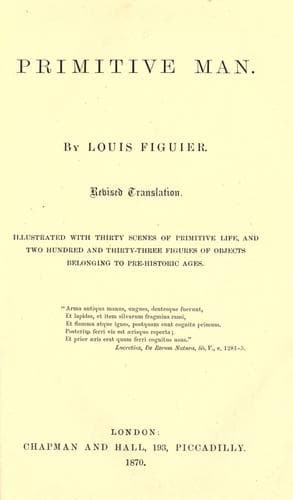
The value of the work to English archæologists, however, is not merely
that of a clear popular manual; pre-historic archæology, worked as it
has been in several countries, takes in each its proper local colour,
and brings forward its proper local evidence. It is true that much of
its material is used as common property by scientific men at large. But,
for instance, where an English writer in describing the ancient cave-men
would dwell especially on the relics from the caves of Devon and
Somerset as worked by Falconer and Pengelly, a French writer would take
his data more amply from the explorations of caves of the south of
France by De Vibraye, Garrigou, and Filhol--where the English teacher
would select his specimens from the Christy or the Blackmore Museum, the
French teacher would have recourse to the Musée de Saint-Germain. Thus
far, the English student has in Figuier's 'Primitive Man' not a work
simply incorporated from familiar materials, but to a great extent
bringing forward evidence not readily accessible, or quite new to him.
Some corrections and alterations have been made in the English edition.
The illustrations are those of the original work; the facsimiles of
pre-historic objects have been in great part drawn expressly for it, and
contribute to its strictly scientific value; the page illustrations
representing scenes of primitive life, which are by another hand, may
seem somewhat fanciful, yet, setting aside the Raffaelesque idealism of
their style, it will be found on examination that they are in the main
justified by that soundest evidence, the actual discovery of the objects
of which they represent the use.
The solid distinctness of this evidence from actual relics of
pre-historic life is one of the reasons which have contributed to the
extraordinary interest which pre-historic archæology has excited in an
age averse to vague speculation, but singularly appreciative of
arguments conducted by strict reasoning on facts. The study of this
modern science has supplied a fundamental element to the general theory
of civilisation, while, as has been the case with geology, its bearing
on various points of theological criticism has at once conduced to its
active investigation, and drawn to it the most eager popular attention.
Thus, in bringing forward a new work on 'Primitive Man,' there is
happily no need of insisting on the importance of its subject-matter, or
of attempting to force unappreciated knowledge on an unwilling public.
It is only necessary to attest its filling an open place in the
literature of pre-historic archæology.
E. B. T.
CONTENTS.
PAGE
INTRODUCTION 1
THE STONE AGE.
I.
THE EPOCH OF EXTINCT SPECIES OF ANIMALS; OR, OF THE GREAT BEAR AND
MAMMOTH.
CHAPTER I.
Public-domain text, read in full here on John Shaqi.
Reviews
Reviews
No reviews yet
Be the first to share your thoughts on this work.
Join the Discussion
Join the discussion
Sign in to leave a comment or review.
Sign InorCreate an account