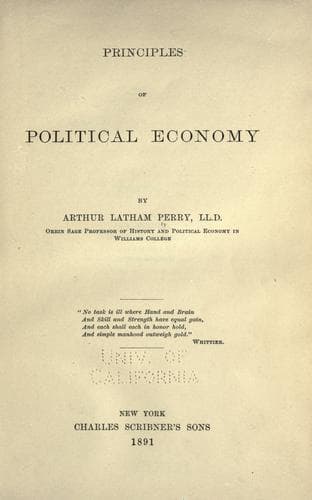
Principles of Political EconomyPerry, Arthur Latham
General
Principles of Political Economy
Perry, Arthur Latham
Economics
At a given signal from the manager the (say) 60 bank messengers, each
standing in front of the desk of his own bank and each having in hand
before him 59 small parcels of papers, the parcels arranged in the
same definite order as the desks around the room, step forward to the
next desk and deliver each his parcel to the clerk sitting behind it,
and so on till the circuit of the room is made. It takes but ten
minutes. Each parcel is made up of cheques or credit-claims, the
_property_ of the bank that brings it and the _debts_ of the bank to
which it is delivered. Accordingly each bank of the circle receives
through its sitting clerk its own _debits_ to all the rest of the
banks, and delivers to all through its standing messenger its own
_credits_ as off-set. In other words, each bank buys of the rest what
it owes to each with what each owes to it. It is at bottom a mutual
buying and selling of debts. There is of course a daily balance on one
side or the other between every two of these banks, which must be
settled in money, because it would never happen in practice that each
should owe the other precisely the same sum on any one day; but
substantially and almost exclusively the exchange at the
Clearing-House is a simple trade in credit-claims. Each bank pays its
debts by credits. A merchant is a dealer in commodities, a laborer is
a dealer in services, and a banker is a dealer in credits. Each of the
three is a buyer and seller alike, and the difference is only in the
kind of valuables specially dealt in by each. In all cases alike,
however, there is no buying without selling and no selling without
buying; because, when one buys he must always pay for what he buys and
that is selling, and when one sells he must always take his pay for
what he sells and that is buying. This is just as true when one credit
is bought or sold against a commodity or a service, and when two or
more credits are bought and sold as against each other, as it is when
two commodities or two services are exchanged one for the other.
But the Clearing-House is not by any means the only place where
credits or debts (they are the same thing) are bought and sold. Every
bank is such a place. Every broker's office is such a place. Every
place is an establishment of the same kind where commercial rights,
that is, claims to be realized in future time and for which a
consideration is paid, are offered for sale and sold. The amount of
transactions in Credits in every commercial country undoubtedly
surpasses the amount in Commodities or that in Services.
Public-domain text, read in full here on John Shaqi.
Reviews
Reviews
No reviews yet
Be the first to share your thoughts on this work.
Join the Discussion
Join the discussion
Sign in to leave a comment or review.
Sign InorCreate an account