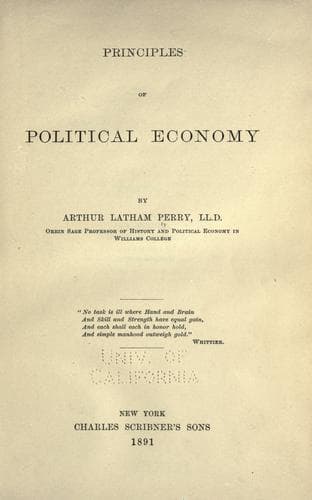
Principles of Political EconomyPerry, Arthur Latham
General
Principles of Political Economy
Perry, Arthur Latham
Economics
What is it that binds all these persons together? A little tarrying in
the Treasurer's office will answer this question for our observer and
for us. He will find it to be the second kind of Buying and Selling.
At stated times the Treasurer pays the salary of the Agent, and his
own. He pays the wages of the Overseers and the wages of all the
Operatives and Laborers,--men and women and children. Here he finds a
buying and selling on a great scale not of material commodities as
before, but of personal services of all the various kinds. Every man
and woman and child connected with the factory and doing its work
sells an intangible personal service to the "Company" and takes his
pay therefor, which last is a simple buying on the part of the unseen
employers. Here, then, in this mill is a single specimen of this
buying and selling of personal services, which is going on to an
immense extent and in every possible direction in each civilized
country of the world, and everywhere to an immensely increased volume
year by year. Clergymen and lawyers and physicians and teachers and
legislators and judges and musicians and actors and artisans of every
name and laborers of every grade sell their intangible services to
Society, and take their pay back at the market-rate. The aggregate
value of all these services sold in every advanced country is probably
greater than the aggregate value of the tangible commodities sold
there. At any rate, both classes alike, commodities and services, are
bought and sold under substantially the same economic principles.
The inductive appetite in intelligent persons, that is to say, their
desire to classify facts and to generalize from particulars, almost
always grows by what it feeds on; and our supposed observer will
scarcely rest contented until he has taken up at least one more
stand-point, from which to observe men's Buying and Selling. Suppose
now he enter for this purpose on any business-day morning the New York
Clearing-House. He will see about 125 persons present, nearly one half
of these bank clerks sitting behind desks, and the other half standing
before these desks or moving in cue from one to the next. The room is
perfectly still. Not a word is spoken. The Manager of the Clearing
with his assistant sits or stands on a raised platform at one end of
the room, and gives the signal to begin the Exchange. No commodities
of any name or nature are within the field of view. The manager indeed
and his assistant and two clerks of the establishment who sit near him
are in receipt of salaries for their personal services, and all the
other clerks present receive wages for their services from their
respective banks, but the exchange about to commence is no sale of
personal services any more than it is a sale of tangible commodities.
It is however a striking instance of the buying and selling of some
valuables of the third and final class of valuable things.
Public-domain text, read in full here on John Shaqi.
Reviews
Reviews
No reviews yet
Be the first to share your thoughts on this work.
Join the Discussion
Join the discussion
Sign in to leave a comment or review.
Sign InorCreate an account