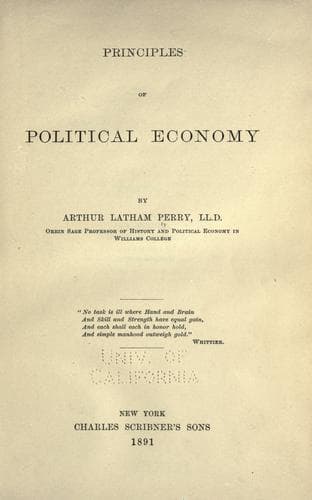
Principles of Political EconomyPerry, Arthur Latham
General
Principles of Political Economy
Perry, Arthur Latham
Economics
Now while patents and copyrights are a monopoly under the definition,
they are quite distinct in their purpose and spirit from the
monopolies already described. On the whole, Society does well in
trying to protect, by law, inventors and thinkers in the sole use and
benefit of their respective products for a brief and specified time.
There are large difficulties in the way of reaching this end
practically, as is proven by the endless and expensive lawsuits in
such cases, but the postulate on which it is attempted is sound,
namely, that otherwise citizens would have less motive to think and to
invent; since in that case only the public-spirited and the rich could
or would devote themselves to an important branch of the public
progress. A patent or copyright is merely a return service which
Society renders for a service received. It violates no man's right of
property, as an ordinary monopoly does, but on the other hand is a
provision to protect for a time a new right of property created by the
thought and efforts of a deserving class of men. The phrase,
"intellectual property," used above in translating from the German, is
not well chosen, since we have amply learned that anything is property
that can be bought and sold, that simple rights of many kinds are
constantly on sale in the market, and consequently that patents and
copyrights are at once proper and property because they are a
technical return-service for other services ready to be rendered to
the community.
(b) Revenue Rights. Once at a court ball, Napoleon the First noticed a
lady very richly dressed and wearing splendid diamonds, and on asking
for her name, ascertained that she was the wife of a tobacco
manufacturer of Paris; whereupon it occurred immediately to the quick
mind of the French ruler, that the State might just as well have those
great profits as an individual; and the sale of tobacco in all its
forms became accordingly a State monopoly in the interest of taxation,
and so it has continued to this day, and yields now about 400,000,000
francs a year. Other nations have adopted to some small extent this
mode of indirect taxation of their people. By legally cutting off the
competition of all private dealers in the taxed article, and by
preventing to the utmost of their power its being smuggled into the
country, Governments are enabled to sell the article at a price
enhanced artificially by the monopoly; but all that the people are
made to pay _extra_ under the monopoly, saving the costs of
maintaining it, goes directly into the treasury of the State; and, so
far forth, becomes an unobjectionable mode of taxation. Under all
forms of taxation, the aim should clearly be, that the Treasury
receive all that the People are made to pay, except the cost of an
economical collection.
Public-domain text, read in full here on John Shaqi.
Reviews
Reviews
No reviews yet
Be the first to share your thoughts on this work.
Elsewhere in the archive
Join the Discussion
Join the discussion
Sign in to leave a comment or review.
Sign InorCreate an account