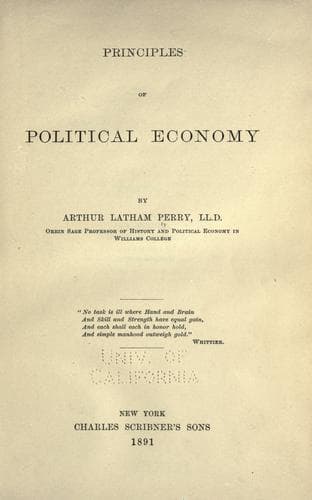
Principles of Political EconomyPerry, Arthur Latham
General
Principles of Political Economy
Perry, Arthur Latham
Economics
Damascus is one of the very oldest cities of the world, and its very
name means a "_seat of trade_." We are told in the Scriptures, that
Abraham about 2000 years before Christ went up out of Egypt "very rich
in cattle, in silver, and in gold," and the only possible way he could
have acquired these possessions was by buying and selling. He
afterwards purchased the cave and the field in Hebron for a family
burial-place, and "weighed unto Ephron the silver which he had named
in the audience of the sons of Heth, four hundred shekels of silver,
current money with the merchant." We may notice here, that there were
then "merchants" as a class, that silver by weight passed as "money"
from hand to hand, and that in the lack of written deeds to land, as
we have them, sales were "made sure" before the faces of living men,
who would tell the truth and pass on the word. Abraham indeed seems to
have given the pitch for the song of trade sung by his descendants,
the Jews, from that day to this; for Jacob, his grandson, was a
skilled trafficker, not to say a secret trickster, in his bargains;
and wherever in the Old World or the New the Jews have been, _there_
have been in fact and in fame busy buyers and sellers.
But the Jews have had no special privileges in the realm of trade; on
the contrary, they have always been under special disabilities both
legal and social. Even in England, the most liberal country in Europe,
they were exiled for long periods, maltreated at all points of contact
with other people, more or less put under the ban of the Common and
the Statute law, often outrageously taxed on their goods and persons,
and studiously kept out of the paths of highest public employment even
down to a time within the memory of living men.[1] Yet so natural is
the impulse to trade, so universally diffused, so imperative also if
progress is in any direction to be attained, that the English and all
other peoples were as glad to borrow money, that is, buy the use of
it, of the persecuted Jews, as the latter were to get money by buying
and selling other things, and then to loan it, that is, sell the use
of it, under the best securities (never very good) for its return with
interest, that they could obtain. Happily, the mutual gains that
always wait on the Exchanges even when their conditions are curtailed,
of course attended the mutilated exchanges between Jews and
Christians: otherwise, they would not continue to take place.
Public-domain text, read in full here on John Shaqi.
Reviews
Reviews
No reviews yet
Be the first to share your thoughts on this work.
Join the Discussion
Join the discussion
Sign in to leave a comment or review.
Sign InorCreate an account