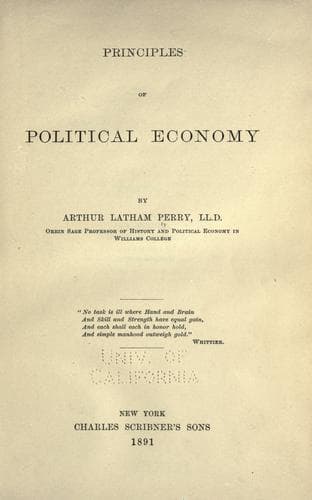
Principles of Political EconomyPerry, Arthur Latham
General
Principles of Political Economy
Perry, Arthur Latham
Economics
Christianity, however, as the perfected Judaism, gradually brought in
the better conditions, the higher impulses, and the more certain
rewards, of Trade, all which, we may be sure, were designed in the
divine Plan of the world. What is called the Progress of Civilization
has been marked and conditioned at every step by an extension of the
opportunities, a greater facility in the use of the means, a more
eager searching for proper expedients, and a higher certainty in the
securing of the returns, of mutual exchanges among men. There have
been indeed, and there still are, vast obstacles lying across the
pathway of this Progress in the unawakened desires and reluctant
industry and short-sighted selfishness of individuals, as well as in
the ignorant prejudices and mistaken legislation of nations; but all
the while Christianity has been indirectly tugging away at these
obstacles, and Civilization has been able to rejoice over the partial
or complete removal of some of them; while also Christianity directly
works out in human character those chief qualities, on which the
highest success of commercial intercourse among men will always
depend, namely, Foresight, Diligence, Integrity, and mutual Trust; so
that, what we call Civilization is to a large extent only the result
of a better development of these human qualities in domestic and
foreign commerce.
Contrary to a common conception in the premises, the sacred books of
both Jews and Christians display no bias at all against buying and
selling, but rather extol such action as praiseworthy, and also those
qualities of mind and habits of life that lead up to it and tend too
to increase its amount, and they constantly illustrate by means of
language derived from traffic the higher truths and more spiritual
life, which are the main object of these inspired writers. It is
indeed true that the chosen people of God were forbidden to take Usury
of each other, though they were permitted to take it freely of
strangers, and that they were forbidden to buy horses and other
products out of Egypt, for fear they would be religiously corrupted by
such commercial intercourse with idolaters; but there is nothing of
this sort in the law of Moses that cannot be easily explained from the
grand purpose to found an agricultural commonwealth for religious
ends, in which commonwealth no family could permanently alienate its
land, and in which it was a great object to preserve the independence
and equality of the tribes and families. Throughout the Old Testament
there is no word or precept that implies that trade in itself is not
helpful and wholesome; there were sharp and effective provisions for
the recovery of debts; there were any number of exhortations to
diligence in business, such as, "_In the morning sow thy seed, and at
evening withhold not thy hand_"; King Solomon himself made a gigantic
exchange in preparation for the temple with King Hiram of Tyre, by
Public-domain text, read in full here on John Shaqi.
Reviews
Reviews
No reviews yet
Be the first to share your thoughts on this work.
Join the Discussion
Join the discussion
Sign in to leave a comment or review.
Sign InorCreate an account