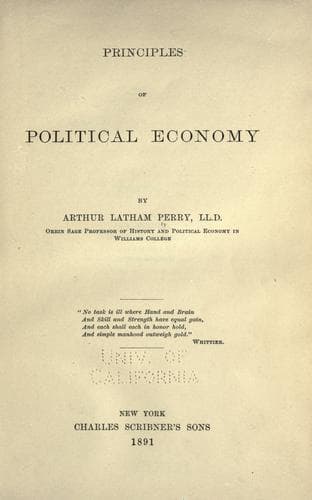
Principles of Political EconomyPerry, Arthur Latham
General
Principles of Political Economy
Perry, Arthur Latham
Economics
(c) Finally, in this connection, it is easy enough to see, what were
the motives on the part of the landlords, and what were the results on
the part of the masses, of Great Britain, in putting on and keeping on
the infamous Corn Laws, so-called, which were repealed forever in
1846. The Corn Laws forbade the importation of foreign cereals under
heavy pecuniary penalties. The simple purpose of the landlords then
governing England was to raise the price of their grain by shutting
off Competition of foreigners by means of these prohibitory
tariff-taxes. It was Protectionism pure and simple. It was designed to
raise the price of bread to the masses of their countrymen, and often
did raise it to the point of their starvation. But we have just seen,
that the higher the price of the produce, the wider the margin for
Rent for the lands that produce it. The Corn Laws of England enriched
the landlords at the expense of all other classes and to the
starvation of many of the poor. As has been well said, this was the
most successful of all the many expedients that have been tried, "_to
fertilize the rich man's land by the sweat of the poor man's brow_."
The words of Daniel O'Connell, spoken Sept. 28, 1843, in his
parliamentary fight against the high-tariff Corn Laws, were surfeited
with truth and righteousness: "_But what is the meaning of
'Protection'? It means an additional sixpence for each loaf; that is
the Irish of it. If the landlord had not the protection, the loaf
would sell for a shilling, but if he has protection, it will sell for
one and sixpence. Protection is the English for sixpence; and what is
more, it is the English for an extorted sixpence. The real meaning of
'Protection,' therefore, is robbery,--robbery of the poor by the
rich._"
Public-domain text, read in full here on John Shaqi.
Reviews
Reviews
No reviews yet
Be the first to share your thoughts on this work.
Elsewhere in the archive
Join the Discussion
Join the discussion
Sign in to leave a comment or review.
Sign InorCreate an account