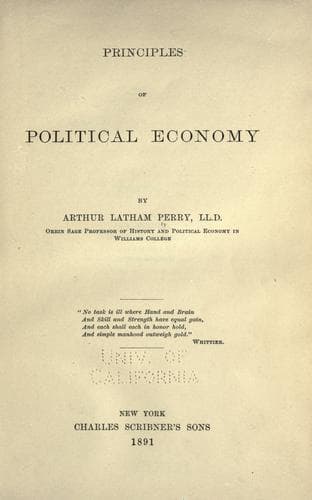
Principles of Political EconomyPerry, Arthur Latham
General
Principles of Political Economy
Perry, Arthur Latham
Economics
One of our Lord's parables, the parable of the Talents, sets forth in
several striking lights the privilege and duty and reward of diligent
trading. "_Then he that had received the five talents went and traded
with the same, and made them other five talents._" And when this
servant came to the reckoning, and brought as the result of his free
and busy traffic "_five talents more_," the prompt and hearty approval
of his lord--"well done, thou good and faithful servant"--becomes the
testimony of the New Testament to the merit and the profit and the
benefit of a vigorous buying and selling. For this servant could not
have been authoritatively pronounced good and faithful if the results
of his action commended had been in any way prejudicial to others. The
truth is, as we shall abundantly see by and by with the reasons of it,
that any man who buys and sells under the free and natural conditions
of trade, benefits the man he trades with just as much as he benefits
himself. But the parable has a still stronger word in favor of
exchanges. There was another servant also entrusted with capital by
his lord at the same time, when the latter was about to travel "_into
a far country_." We are expressly told that distribution was made "_to
every man according to his several ability_," and thus this servant
was only entrusted with a single talent, the size of the capital given
to him being in just proportion to the size of the man,--the smallest
share falling of course to the smallest man. But he had the same
opportunity as the two others. The world was open to him. Capital was
in demand, if not in those parts then in some other, to which, like
his lord, he might straightway take his journey. But when his time of
reckoning came, and he had nothing to show for the use of his capital,
he upbraided his lord as a hard man for expecting any increase, and
brought out his bare talent wrapped in a napkin, saying, "_I was
afraid, and I went and hid thy talent in the earth_." His wise lord at
once denounced this servant as "_wicked and slothful_," insisted that
his money ought to have been "_put to the exchangers_," and said
finally in a just anger "_cast ye the unprofitable servant into outer
darkness_."
Public-domain text, read in full here on John Shaqi.
Reviews
Reviews
No reviews yet
Be the first to share your thoughts on this work.
Join the Discussion
Join the discussion
Sign in to leave a comment or review.
Sign InorCreate an account