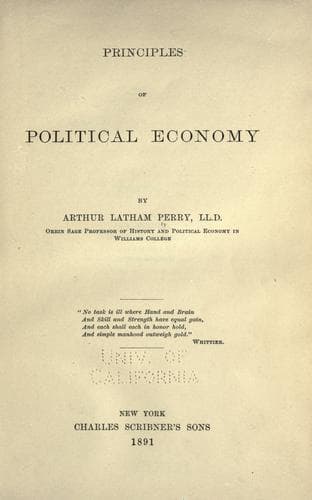
Principles of Political EconomyPerry, Arthur Latham
General
Principles of Political Economy
Perry, Arthur Latham
Economics
which the cedars of Lebanon were to be paid for by the grain and oil
of the agricultural kingdom; chapter xxvii of the prophet Ezekiel is a
graphic description of the commerce of the ancient world as it
centered in the market of Tyre, a description carried out into detail
both as to the nations that frequented that market and as to the
products that were exchanged in it,--"_silver, iron, tin, lead,
persons of men, vessels of brass, horses, horsemen, mules, horns of
ivory, ebony-wood, carbuncles, purple work, fine linen, corals,
rubies, wheat, pastry, syrup, oil, balm, wine of Helbon, white wool,
thread, wrought iron, cassia, sweet reed, cloth, lambs, rams, goats,
precious spices, precious stones, splendid apparel, mantles of blue,
embroidered work, chests of damask, and gold_"; and chapter xxxi of
Proverbs describes the model housewife in terms like these,--
"_The heart of her husband trusteth in her,
And he is in no want of gain.
She seeketh wool and flax,
And worketh willingly with her hands.
She is like the merchants' ships;
She bringeth her food from afar.
She riseth while it is yet night,
And giveth food to her family,
And a task to her maidens.
She layeth a plan for a field and buyeth it;
With the fruit of her hands she planteth a vineyard.
She perceiveth how pleasant is her gain,
And her lamp is not extinguished in the night.
She putteth forth her hands to the distaff,
And her hands take hold of the spindle.
She maketh for herself coverlets;
Her clothing is of fine linen and purple.
She maketh linen garments and selleth them,
And delivereth girdles to the merchants._"
Still more explicit and instructive are the words and spirit of the
New Testament. There cannot be the least doubt that the whole
influence of Christianity is favorable to the freest commercial
exchanges at home and abroad, because these depend largely on mutual
confidence between man and man, of which confidence Christianity is
the greatest promoter. It may be conceded at once that our Lord
"_overthrew the tables of the money-changers and the seats of them
that sold doves_" within the sacred precincts of the temple, but
this, not because it is wrong to change money or sell doves, but
because that was not the _place_ for such merchandising; so He himself
explained his own action in the sequel; provincial worshippers coming
up to Jerusalem must needs have their coins changed into the money of
the Capital, and must needs buy somewhere the animal victims for
sacrifice; but the whip of small cords had significance only as to the
_place_, and not at all as to the _propriety_, of such trading.
Public-domain text, read in full here on John Shaqi.
Reviews
Reviews
No reviews yet
Be the first to share your thoughts on this work.
Join the Discussion
Join the discussion
Sign in to leave a comment or review.
Sign InorCreate an account