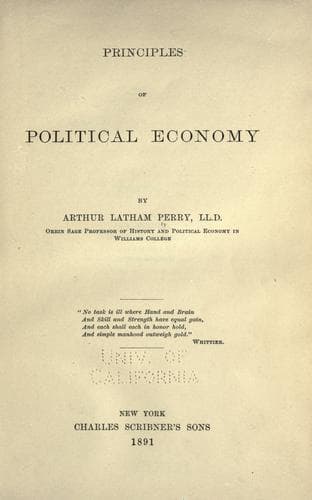
Principles of Political EconomyPerry, Arthur Latham
General
Principles of Political Economy
Perry, Arthur Latham
Economics
Skilled Laborers are those, who have had to pass through something
equivalent to an apprenticeship in order to be able to offer their
services for sale. These, as a class, present some considerable points
of difference from common laborers. Their numbers are fewer, for the
reason, that relatively few parents can afford to give their children
the time and money needful for them to learn a trade, or to become
skilful in any art requiring prolonged education; as a result of this
lessened press of competition among themselves, and because being
intelligent and consequently mobile they are able to insist better on
their claims and distribute themselves to points where their services
are in more demand; and because they are likely to be subject to a
stronger Demand than common laborers, on account of the close
connection of their services with special accumulations of Capital;
the Wages of skilled laborers will infallibly rule higher than those
of common laborers. Artisans in general constitute this second class
of laborers.
Professional Laborers are those, who have received a technical
education,--something more than an apprenticeship,--expressly to fit
them to render difficult and delicate services to their fellow-men for
pay, and who possess besides the requisite character and talents and
genius to enable them to succeed. Clergymen, physicians, lawyers,
literary men, artists, actors, and many more, render professional
services loosely so-called. The obstacles at the entrance of this path
occasioned by the lack (1) of appropriate natural gifts, or (2) of the
requisite industry and character, or (3) of the means of suitable
education and training, practically exclude so many persons, that the
competition in the higher walks of professional life is not such as to
prevent a very large remuneration for services rendered. The demand
for these is often peculiarly intense, as well as the supply
peculiarly limited. When great interests of property, of reputation,
of life, are at stake, it is felt that the best men to secure these
must be had at almost any price. Fees and rewards for services of
great delicacy, of great difficulty, of great danger, are paid by
individuals and corporations and nations without grudging.
Comparatively few men reach the highest points of excellence in their
respective professions, and they have in consequence a natural
monopoly in these fields of effort, and receive for their labor a very
high rate of Wages. For example, Daniel Webster often took a fee of
$1000 for a single plea in court; Paganini, a like sum for an hour's
playing on a violin; and Jenny Lind, at least as much for an evening's
singing in a concert, because there was in each case a strong demand
for a peculiar service and only one person in the world who could
render that service in the circumstances to the same perfection. But
the objections which lie with such force against artificial
monopolies, cannot be urged at all against a natural monopoly; for, if
Public-domain text, read in full here on John Shaqi.
Reviews
Reviews
No reviews yet
Be the first to share your thoughts on this work.
Elsewhere in the archive
Join the Discussion
Join the discussion
Sign in to leave a comment or review.
Sign InorCreate an account