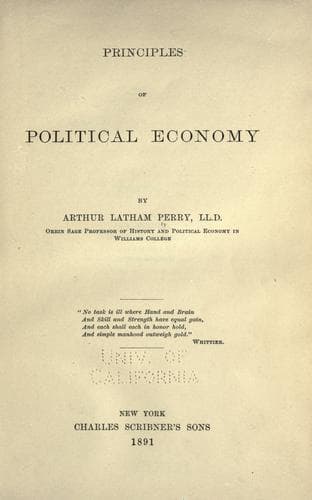
Principles of Political EconomyPerry, Arthur Latham
General
Principles of Political Economy
Perry, Arthur Latham
Economics
Such men sometimes have sons or _protégés_, who possess similar
capacities and similar integrity, and these by experience become able
to carry on the business to similar successful issues. This is happy,
but it is unusual. More commonly, in the second, and pretty certainly
in the third, generation, the line of royal succession fails. There
comes in a lieutenant rather than a captain of Industry. Likely enough
he mistakes the nature of capital, and thinks that it will go along of
itself without that eternal vigilance that is the one price of its
maintenance and increase; likely enough he lacks the touch and rule of
men, and his laborers become demoralized and refractory; more likely
still he thinks he sees other operators around him getting quicker
rich by speculating in enterprises outside the legitimate business,
and takes some of his own and of what is not his own and throws it out
of its proper channels; and, as the result of one or all of these,
things soon go wrong, profits and wages fall off, poor work is done
and finds slow sale, and Demand for laborers (which is their
life-blood) slackens or goes out in that establishment. No wonder the
Paper-makers in their annual gathering at Saratoga of 1889, resolved
as the main outcome of their meeting, that they would bring up their
sons (or somebody's sons) to succeed them in their business by a
thorough practical training in the paper-mill itself, beginning early
and continuing long. Industrial higher education in this or some other
form is the secondary hope of manufacturing business in the United
States, the primary hope being in a decent commercial liberty to buy
their supplies and to sell their products in the best markets wherever
these are to be found.
There is one other important item that bears directly upon the Demand
for laborers of the second class, and consequently upon their Wages,
namely, the constant introduction of more and better Machinery. At
first blush it would seem, and it has often been stated so, that the
use of machinery takes just so much work from human hands, reduces by
so much the Demand for laborers, and tends to lessen by so much their
wages. All this is the opposite of the truth; but before we explain
_why_ it is the opposite of the truth, let us attend carefully to the
truth itself, as stated in 1889 by the highest living authority on
these special points, Sir Edwin Chadwick, the octogenarian pioneer in
sanitary and economic reforms. Fifty-six years ago Chadwick joined
with his colleagues of the English Factory Inspection Board in
recommending reduced hours of labor and other improvements which have
now become general in England. In a paper recently read before the
Political Economy Club, he calls attention to the greatly increased
production which follows improved machinery and shortened hours.
Public-domain text, read in full here on John Shaqi.
Reviews
Reviews
No reviews yet
Be the first to share your thoughts on this work.
Elsewhere in the archive
Join the Discussion
Join the discussion
Sign in to leave a comment or review.
Sign InorCreate an account