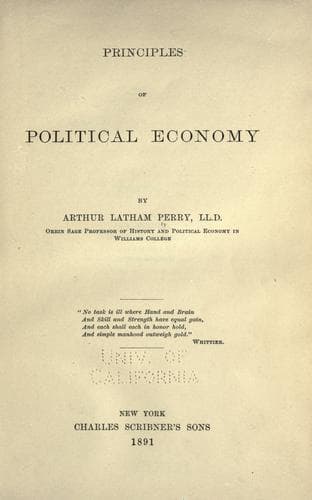
Principles of Political EconomyPerry, Arthur Latham
General
Principles of Political Economy
Perry, Arthur Latham
Economics
He says: "_Spinning machines which formerly turned 8000 in a minute,
now turn 11,000; and in Lancashire not more than half the hands are
now employed to produce the same amount with new machinery as were
employed on the machinery of 1833. As an example of the extent of
the reduction of hands by these improvements, it may be mentioned that
one large family of cotton spinners in Manchester, which 40 years
ago employed 11,000 hands, could not now muster one half that
number._ YET THE MILL POPULATION HAS INCREASED, AS WELL AS THE GENERAL
POPULATION, THE HANDS DISCHARGED BEING ABSORBED IN OTHER EMPLOYMENTS.
_At the beginning of the century the cost of spinning a pound of yarn
was a shilling. The pound of that same yarn is now spun for a
half-penny by hands earning double wages for their increased energetic
attention and skill. It is now found, however, that the strain of the
increased responsible attention cannot be so long sustained as the
slow, semi-automatic pace by the old working of the old mills with the
long hours. Hence there is a tendency to a further voluntary reduction
of the working hours in the best mills, first to nine hours. In one
mill, in which 2000 men are employed a voluntary reduction has been
effected to about eight hours with a more equable production; and I
have heard of other examples. As showing the cost of working with
inferior hands and loose regulations, a recent report from the
Manchester Chamber of Commerce states that 20s. worth of bundled
yarn may be produced at a cost of from 2d. to 3d. per pound less
in Manchester than in Bombay, notwithstanding the hours of working
are 80 hours per week, while in Manchester they are only 50. At
the present time Lancashire, with its short hours, will meet Germany
or any other country, in neutral markets, in the world. In Germany the
spinners and weavers still work 13 hours a day as they once did in
England; France has only come down to 12 hours; whereas the English
rate has long been 10 hours, and may soon be 9 or even 8. And
this reduction improves the health of the wage-workers, while the
reduced cost of production allows them higher wages; yet Germany with
its long hours and high tariff maintains a system_ OF LOW PAY, DEAR
PRODUCTION, HIGH COST OF DISTRIBUTION, AND LIMITED SALES."
Public-domain text, read in full here on John Shaqi.
Reviews
Reviews
No reviews yet
Be the first to share your thoughts on this work.
Elsewhere in the archive
Join the Discussion
Join the discussion
Sign in to leave a comment or review.
Sign InorCreate an account