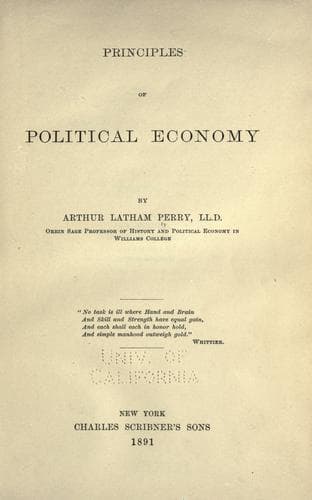
Principles of Political EconomyPerry, Arthur Latham
General
Principles of Political Economy
Perry, Arthur Latham
Economics
(c) This demonstration is extremely important in Political Economy,
and consequently in Social Life; for it proves beyond the possibility
of a cavil, the Value of personal services tends constantly to rise,
not only as compared with the Value of the material commodities which
by the aid of capital they help to create (a truth we have seen
before), but also as compared with the Value of the use of its
co-partner capital itself; and therefore, that there is inwrought into
the very substance of things in this world a tendency towards an
equality of economical condition among men. God has ordered it, and
men cannot radically alter it. Self-interest is indeed the mainspring
of movement in the economic world; but the beauty of it and the wonder
of it is, that no man can labor intelligently and productively under
the influence of self-interest without at the same time benefiting the
masses of men. His fair exchanges benefit the parties of the other
part as much as they benefit himself. His very savings productively
employed are poor men's livings. Only under the blessed freedom of
universal Buying and Selling, subject only to the taxation of a good
Government for public purposes purely, can these broad benefits
designed by a wise Providence be fully realized in action; and the
power of individual greed and corporate privilege and governmental
perversion to thwart the beneficent though complicated workings of
these laws of Capital and Labor towards the common weal and universal
progress of mankind is shortlived and soon punished.
4. How comes it about, then, if these laws of mutual inter-dependence
between capitalists and laborers are so well-placed and Providentially
balanced, that there always have been and are still so many
misunderstandings and ill-feelings and actual collisions between
employers and skilled laborers, whose interests are at bottom one and
whose relations ought to be so cordial? This is the last topic in our
Chapter on Personal Services. Here we must look around narrowly and
tread carefully. But there is a path. We can find it if we will. It
leads through many short-comings in men's characters and through much
ignorance of plain economical truths and past unreasoning jealousies
and aggregated action on the part of both classes, and over the
needful distinctions between impulsive selfishness and a true
self-interest back to the same old laws of God laid down at once in
the constitution of things and in the constitution of men.
Labor-troubles are almost as old as Civilization. The Greek poet
Euripides in his play of the "Supplicants" both indicates facts as
they were then, and points out a future hope in which we may share,
that these middle classes by a better harmony preordained and mutually
beneficial may yet "save the State":--
Public-domain text, read in full here on John Shaqi.
Reviews
Reviews
No reviews yet
Be the first to share your thoughts on this work.
Elsewhere in the archive
Join the Discussion
Join the discussion
Sign in to leave a comment or review.
Sign InorCreate an account