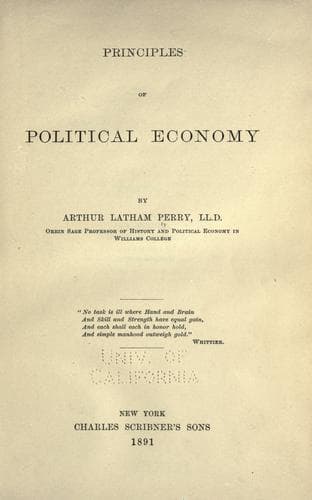
Principles of Political EconomyPerry, Arthur Latham
General
Principles of Political Economy
Perry, Arthur Latham
Economics
"In each State
Are marked three classes: of the public good
The rich are listless, all their thoughts to more
Aspiring; they that struggle with their wants,
Short of the means of life, are clamorous, rude,
To envy much addicted, 'gainst the rich
Aiming their bitter shafts, and led away
By the false glosses of their wily leaders.
'Twixt these extremes there are who save the State,
Guardians of order, and their country's laws."
At Rome and in the Roman Empire, instead of the usual voluntary union
of capitalists and laborers for the mutual advantage of each other,
the laborer was owned by the capitalist, and the true relations
between the two were thoroughly disguised and wretchedly distorted.
Business in all its branches came to be carried on by means of slaves;
the lands were tilled by slaves; slaves became the artisans of the
country; the money-lenders and bankers of the centre scattered
branch-banks in the towns under the direction of their slaves and
freedmen; the Company that leased on speculation the Customs-Taxes
from the State had their slaves and freedmen levy these taxes at each
custom-house; the contractor for buildings bought architect-slaves;
and the merchant imported his goods in ships of his own manned by his
slaves or freedmen, and then sold the same at wholesale or retail by
the same means. In this way a gigantic system of unnatural traffic was
built up and extended. In this way the very name "laborer" became
tainted by the vile system of slavery of which he was a part, and the
distinction itself between capitalist and laborer was obliterated.
"Roman mercantile transactions fully kept pace with the contemporary
development of political power, and were no less grand of their kind."
"The Roman _denarius_ followed up closely the Roman legions." "It is
very possible that, compared with the suffering of the Roman slaves,
the sum of all negro suffering is but a drop" (Mommsen).
We want now to examine critically the CAUSES of these constantly
recurring labor-troubles, the true economical REMEDIES for them, and
in connection with these the futility of the remedies popularly
recommended for low Wages and the disputes between employers and
employed of the second class.
Public-domain text, read in full here on John Shaqi.
Reviews
Reviews
No reviews yet
Be the first to share your thoughts on this work.
Elsewhere in the archive
Join the Discussion
Join the discussion
Sign in to leave a comment or review.
Sign InorCreate an account