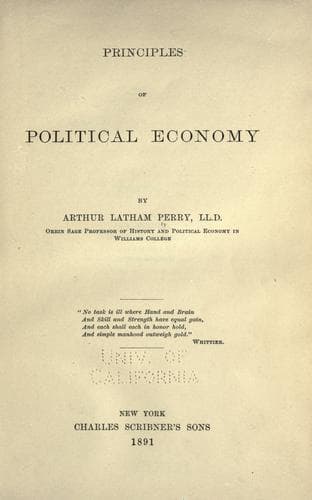
Principles of Political EconomyPerry, Arthur Latham
General
Principles of Political Economy
Perry, Arthur Latham
Economics
(d) _There were also two reciprocal estimates_, the estimate of King
Hiram of all the efforts requisite to cut and hew and float the
timber, as compared with the aggregate of efforts needed to obtain the
necessary wheat and barley and wine and oil in any other possible way;
and the estimate of King Solomon of all the labors required to grow
and market these agricultural products, as compared with what would
otherwise be involved in getting the much-wished-for timbers. Such
estimates invariably precede every rational exchange of products. It
is not in human nature to render a greater effort or the result of it,
when a lesser effort or the result of it will as well procure the
satisfaction of a desire. Efforts are naturally irksome. No more of
them will ever be put forth than is necessary to meet the want that
calls them forth. No man in his senses will ever put more labor on
anything, with which to buy something else, than is necessary to get
that something else by direct effort or through some other exchange.
Here we are on ground as solid as the very substance of truth can make
it. The Jews of Solomon's time were too shrewd and sparing of irksome
labor to devote themselves for years to the toils of the field and of
the vat to get by traffic the materials for their temple, if they
could have gotten those materials by a less expenditure of toil in any
other way. Those Phoenicians of Tyre and Sidon, the born merchants of
the East, the founders of commercial Carthage in the West, if they
could have extorted from the reluctant sands of their coast the
cereals and the vines and olives requisite for their own support with
only so much of exertion as was needed to get that to market with
which to buy them, would never have taken the indirect in preference
to the direct method. They took the indirect, because it was the
easier, and therefore the better.
It may, accordingly, be laid down as a maxim, that men never buy and
sell to satisfy their wants but when that is the easiest and best way
to satisfy them. It saves effort. It saves time. It saves trouble. It
divides labor. It induces skill. It propels progress. But in order to
determine which may be the easier way, requires constant _estimates_
on the part of each party to a possible trade. Shall I shave myself or
go to the barber? Before I decide, I estimate the direct effort in the
light of the effort to get that with which to pay the barber for his
service. If I trade with him, it is because I deem it easier, cheaper
in effort, more convenient in time. Trade means comparisons in every
case--comparisons by both parties--and in the more recondite and
complicated cases, elaborate comparisons and often comprehensive
calculations involving future time.
Public-domain text, read in full here on John Shaqi.
Reviews
Reviews
No reviews yet
Be the first to share your thoughts on this work.
Join the Discussion
Join the discussion
Sign in to leave a comment or review.
Sign InorCreate an account