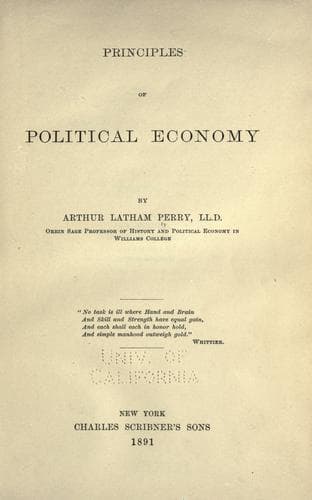
Principles of Political EconomyPerry, Arthur Latham
General
Principles of Political Economy
Perry, Arthur Latham
Economics
Now these estimates inseparable from exchanges, and these
calculations which are a factor in all the far-reaching exchanges, are
mental activities. They quicken and strengthen the _minds_ of men.
Trade is usually, if not always, the initial step in the mental
development of individuals and nations. Desires stir early in the
minds of all children; efforts more or less earnest are the speedy
outcome of natural desires; direct efforts, however, to satisfy these
soon reach their limits; it is now but a step over to simple
exchanges, by which the desires are met indirectly; exchanges once
commenced tend to multiply in all directions, and the estimates that
must precede and accompany these are mental states,--the more of them,
the greater the mental development, the higher the education;
consequently, commerce domestic and foreign is a grand agency in
civilization, a constant and broadening impulse towards progress in
all its forms; and Christianity, as we have already seen, is friendly
to commerce in its every breath. Those, therefore, who talk and preach
about Trade as tending to _materialism_, do not know what they are
talking about. Because Commodities are material things, and because a
portion of the trade of the world concerns itself with commodities,
these shallow thinkers jump to the conclusion that trade is
materialistic. _It is just the reverse._ Let us hear no more from
Professor Pulpit or Platform that buying and selling is antagonistic
to men's higher intellectual and spiritual culture, because the
present careful analysis has brought us indubitably to mental
Estimates and prolonged comparisons, which are activities of Mind, as
the fourth and a leading factor among the radical elements of Sale.
(e) _There were two renderings_, King Hiram's rendering at Joppa the
desired cedars from the mountains of Lebanon, and King Solomon's
rendering in return at Tyre the food products grown in his fertile
country. These renderings were visible to all men. Unlike the desires
and the estimates, which were subjective and invisible; the actual
exchange of the products, the culmination of the previous efforts, the
stipulated renderings by and to each party, were outward and
objective--"known and read of all men." This is the reason why public
attention is always strongly drawn to this particular link of the
chain of events which we are now unlocking and taking apart, while
other links of the series, that are just as essential, almost wholly
escape observation. The ports and the markets are apt to be noisy and
conspicuous, when the desires and the estimates and the satisfactions,
without which in their place there would be no market-places, work in
silence, and leave no records except the indirect one of the
renderings themselves.
Public-domain text, read in full here on John Shaqi.
Reviews
Reviews
No reviews yet
Be the first to share your thoughts on this work.
Join the Discussion
Join the discussion
Sign in to leave a comment or review.
Sign InorCreate an account