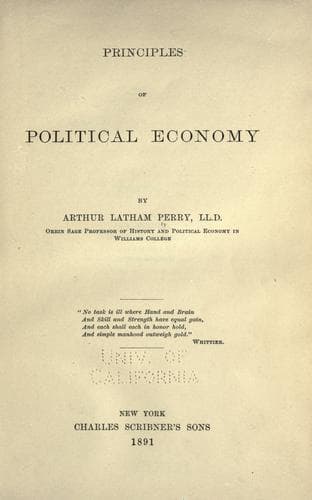
Principles of Political EconomyPerry, Arthur Latham
General
Principles of Political Economy
Perry, Arthur Latham
Economics
_c._ Bank Bills. These are a form of promissory notes not on interest,
and thus differ from the notes of ordinary corporations, and from the
bonds of nations and states and municipalities; but the issuing Bank
offers, as a sort of compensation for the privilege of circulating
notes not on interest, to convert them into coin, that is, to pay them
instantly on the demand of any holder. It is this proffered and
immediate convertibility into coin that enables the promissory notes
of a bank to circulate as money, while the notes of other corporations
and individuals equally solid and solvent do not circulate as money.
It must be borne in mind, however, that this offer to convert them
into the legal and ultimate coin-money does not essentially alter the
nature of Bank Bills; they are a form of commercial credit; and
although they are commonly issued against another form of such credit,
namely, against the interest-bearing promissory notes of individuals
and corporations who resort to the bank for discount, this only
complicates the exchange without changing its nature. It is a common
instance of exchanging one form of credit for another form which
happens to have a greater currency or validity than the first, and for
this superiority of the bank credit the individual credit pays an
interest, in other words, is discounted; and such exchanges of one
form of paper credit for another, with or without a premium, may go on
indefinitely; especially as _credit-money_ in the form of bank bills,
such paper may serve as a medium in many exchanges; but ultimately,
and before the entire series of transactions is closed, such bank
bills are to be redeemed in coin, or taken in by the banker in payment
of some debt due to him, in both which cases they are extinguished as
an instrument of Credit.
The Bank of England keeps out in circulation on the average
£25,000,000 in bank bills. It has been computed, that the average
length of life of a Bank of England bill between its issue and
redemption is about three days; and no bill once redeemed or received
back over the counters of the Bank is ever issued again. It is then
placed on file for record only. The joint-stock and private banks of
England and Wales circulate on the average rather more than £4,000,000
of bank bills of their own; and no bank bill of any kind is legal in
England and Wales of a less denomination than £5. The ten Scotch banks
and their branches keep out in bills about £5,000,000; six out of the
nine Irish banks and their branches issue on the average not far from
£10,000,000; but both the Scotch and Irish banks are allowed to put
out £1 bills.
Public-domain text, read in full here on John Shaqi.
Reviews
Reviews
No reviews yet
Be the first to share your thoughts on this work.
Elsewhere in the archive
Join the Discussion
Join the discussion
Sign in to leave a comment or review.
Sign InorCreate an account