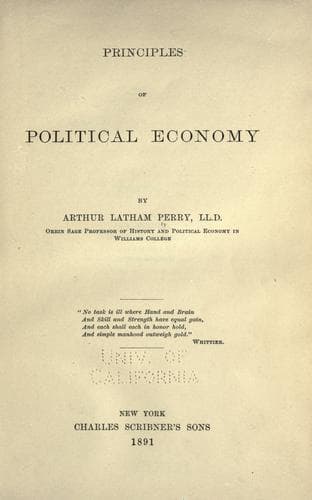
Principles of Political EconomyPerry, Arthur Latham
General
Principles of Political Economy
Perry, Arthur Latham
Economics
Now, as was said a little while ago, perhaps the central function in
banking is for the banker to receive his customer's money and also his
credits falling due, and to render to him in return for these _a
credit_, that is, a right to demand from himself an equal sum at a
future time or times. The evidence of this right is entered on the
banker's books, and usually too on the customer's passbook, and thus
becomes what is called a DEPOSIT. The ownership of the money and of
the credits deposited passes over completely from the customer to the
banker. It is a complete case of buying and selling to the mutual
profit of the parties. The banker has the right to do just what he
pleases with his deposits, and the customer has a right to draw
cheques on his credit as and when he pleases; only the banker's entry
of the transaction on his books is a virtual and a legal _promise_ to
pay that amount to his customer, and therefore he must be ready to
respond to his customer's call, whenever the latter demands, not his
own money, but so much of his banker's money. _A deposit, accordingly,
is not the very thing deposited, but a credit._ It is the banker's
promise and the depositor's property. It is in this way that a banker
buys ready money with a credit.
The motive, then, that leads the depositor to intrust his money to the
banker is the desire, not to have that specific money kept safely for
him, for he lost possession of it absolutely when it passed the
counter, he _sold_ it and took his pay in something else, but rather
to have the unquestioned right to call on the banker for such sums
(not to exceed the deposit in the aggregate) and at such times as may
suit his own convenience. He has such confidence in the integrity and
solvency of the banker, finds it so practically convenient to have
dealings with him, and comes to have certain minor privileges at the
bank in other relations over non-depositors, that he quite prefers a
credit on the banker to the possession of the money itself.
The corresponding motive of the banker to receive his customer's funds
on these terms is that he finds by experience (his own and others'),
that he can safely use a large portion of these moneys deposited in
other operations in credit profitable to himself, and at the same time
be practically sure of meeting all his customer's calls for money as
they are made. Every good banker finds out, that many of his customers
wish always to leave a balance in his hands; that while some of them
are constantly drawing cheques on him for cash, others of them are as
constantly depositing with him in cash; and that consequently he can
properly and safely use a large part of the money he has purchased
with his credit to purchase other credits with. Deposit-banking,
therefore, is not only convenient and profitable for the depositor,
but also excellent and profitable for the banker.
Public-domain text, read in full here on John Shaqi.
Reviews
Reviews
No reviews yet
Be the first to share your thoughts on this work.
Elsewhere in the archive
Join the Discussion
Join the discussion
Sign in to leave a comment or review.
Sign InorCreate an account