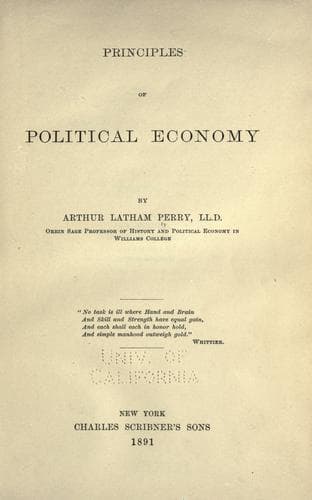
Principles of Political EconomyPerry, Arthur Latham
General
Principles of Political Economy
Perry, Arthur Latham
Economics
Besides these two parties benefited, there is a gain, too, for the
community at large in deposit-banking; inasmuch as a new capital as
such has been thereby created, a series of new values, which would not
otherwise have existed at all. Were there no deposit-bank in that
locality, every man now a customer of it would of course keep his own
reserves for himself for prospective contingencies: now, all these
little reserves are aggregated in the bank, the convenience of them
for each customer's contingencies is just as great as if he kept his
own in his own safe or wallet, but the banker finds that he can use,
say two-thirds of the whole, and still answer each customer's call.
Here is a new capital. Here are scattered valuables brought together
to be loaned out to a profit, which were otherwise barren and useless
for the time being. Industry is quickened in a wide circle, products
are created and brought to market, wages are paid and profits are
gained, in direct consequence of bringing together under favorable
auspices for safe loaning the little hoards and driblets of many
individuals, which were practically useless in isolated hands.
It may easily be objected at this point, that it is entirely possible
that any banker might be called upon to pay off all his
deposit-liabilities at once in money, which, if it happened, would
break him of course; so it is abstractly possible that all the lives
insured in a Life Insurance Company might terminate in one day, in
which case no Company in the world could meet its obligations; and so
it is abstractly possible that all the houses insured in a Fire
Insurance Company might be burned up in a single night, which, if it
happened, would cause the collapse of the soundest company; but in all
these cases of possibility there is a _certainty_ that the possibility
will not become a fact. _Ex nihilo nihil fit._ A supposition
practically impossible to become a fact can yield no logical inference
whatever. The Greek language has a special grammatical form for a
hypothesis impossible to be realized in fact: would that the English
had also such a form of speech! It would save us a mess of bad
reasoning. If, however, any banker may have misjudged for his locality
at any time the proper ratio of reserves kept to deposits received,
and be crowded in consequence, he must sell some of the securities
bought with the excess, or borrow money on them.
Public-domain text, read in full here on John Shaqi.
Reviews
Reviews
No reviews yet
Be the first to share your thoughts on this work.
Elsewhere in the archive
Join the Discussion
Join the discussion
Sign in to leave a comment or review.
Sign InorCreate an account