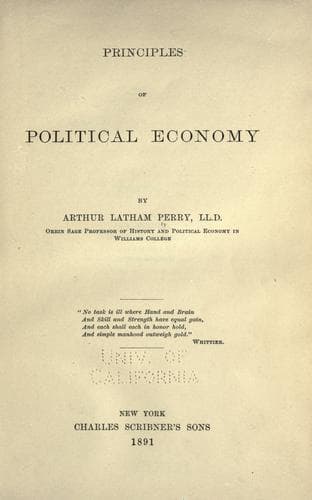
Principles of Political EconomyPerry, Arthur Latham
General
Principles of Political Economy
Perry, Arthur Latham
Economics
These Circular Notes approximate in certain respects in kind towards
the cheques of the Cheque-Bank of London: both are bought at the
outset and paid for in full on the spot; and both are drawn _upon one
Bank_, which is the ultimate Drawee and Payer. In two essential
respects, however, the notes differ from the cheques: the cheques are
payable to Bearer without any indorsement by anybody, and so have a
much more _generalized_ purchasing-power than the notes, which have to
be indorsed by the payee (not named indeed in the notes but in the
letter accompanying them), as they are negotiated in a way preliminary
to their ultimate payment by the single bank on which they are drawn;
and also the notes, like all other foreign bills of exchange, are
subject in their value to the fluctuations of International Exchange,
while the cheques in their value are independent of commercial
exchanges "in favor" or "against" any country, and entitle the bearer
to so many pounds sterling in value according to English coinage
without any possible discount or premium. These London Cheques,
accordingly, approach much nearer to the character of Money than any
other form of Credit yet devised, except Bank bills undoubtedly
convertible; and already take their place as one of the _media_ in the
international trade, and are sold in New York by authorized agents of
the Cheque-Bank, as they have long been by such agents in all English
and Colonial and in many foreign cities.
These _Ten_ are the principle instruments in Credit-Exchanges
throughout the world; and we pass now, as proposed, to the next
section of our subject, namely, the Advantages of Credit.
3. As introducing these advantages and also as illustrating them, we
call attention first to the antiquity of many of the forms of Credit,
a point upon which much fresh light has been cast by recent
discoveries in, and ability to decipher the cuneiform writing of, the
ancient Assyria and Babylonia. It is to the credit of Credit, that the
earliest of civilized men seem to have perceived its nature, to have
seized upon its powers, and to have realized for themselves some of
its advantages. Credit is natural and legitimate. The moderns have
invented new forms of it, and have tested its capacities to the
utmost, but the ancients know it well in several of its instruments,
and vindicate their own insight into the recesses of Exchanges by
tablets and documents now known and read of all men.
Public-domain text, read in full here on John Shaqi.
Reviews
Reviews
No reviews yet
Be the first to share your thoughts on this work.
Elsewhere in the archive
Join the Discussion
Join the discussion
Sign in to leave a comment or review.
Sign InorCreate an account