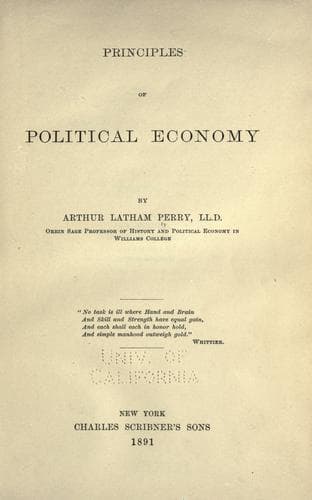
Principles of Political EconomyPerry, Arthur Latham
General
Principles of Political Economy
Perry, Arthur Latham
Economics
In an earthenware jar found some years ago in the neighborhood of
Hillah, a few miles from Babylon, were discovered many clay tablets
inscribed with records relating to banking, and, what is more, to
banking as carried on for generations by a single family or firm,
which the cuneiform archæologists have translated as "Egibi & Co."
These tablets are now deposited in the British Museum. Those who can
read them say, that the founder of this banking-house, Egibi, probably
lived in the reign of Sennacherib, about 700 B.C. This family has been
traced in banking transactions during a century and a half, and
through five generations down to the reign of Darius. They were the
Rothschilds in the region of the Euphrates: they acted in a sort as
the national bank of Babylon.
The Tigris is always associated with the Euphrates and forever will
be. Nineveh on the former river, like Babylon on the latter, has
yielded from its tablet-records information as to the use of credit in
the more northern capital of Assyria. "Within the palace of
Asshur-bani-pal, the Sardanapalus of the Greeks, who reigned at
Nineveh from 668 B.C., Layard discovered what is known as the Royal
Library. There were two chambers, the floors of which were heaped with
books, like the Chaldean tablets already described. The number of
books in the collection has been estimated at ten thousand. The
writing upon some of the tablets is so minute that it cannot be read
without the aid of a magnifying-glass. We learn from the inscriptions
that a librarian had charge of the collection. Catalogues of the
books have been found, made out on clay tablets. The library was open
to the public, for an inscription of Asshur-bani-pal says, "_I wrote
upon the tablets_; _I place them in my palace for the instruction of
my people._" The Assyrian tablets embrace a great variety of subjects;
the larger part, however, are lexicons and treatises on grammar, and
various other works intended as text-books for scholars. Perhaps the
most curious of the tablets yet found are notes issued by the
Government, and made redeemable in gold and silver on presentation at
the King's treasury. Tablets of this character have been found bearing
date as early as 625 B.C. It would seem from this that the Assyrians
had very correct notions of the promise-character of paper (tablet)
money" (Myers).
Public-domain text, read in full here on John Shaqi.
Reviews
Reviews
No reviews yet
Be the first to share your thoughts on this work.
Elsewhere in the archive
Join the Discussion
Join the discussion
Sign in to leave a comment or review.
Sign InorCreate an account