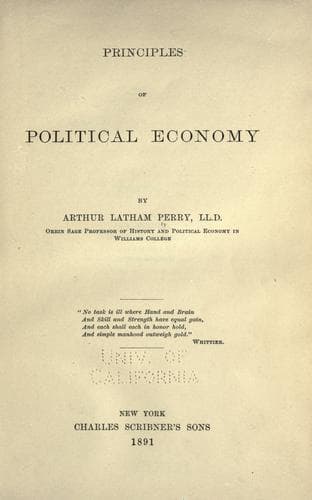
Principles of Political EconomyPerry, Arthur Latham
General
Principles of Political Economy
Perry, Arthur Latham
Economics
but when credit is used freely in addition, and increased purchases go
on in all departments at once, there is apt to be a rise of prices as
to all commodities and a universal spirit of speculation.
At such times, and while prices are still rising, men _seem_ to be
making great gains; everybody wishes to extend his operations by
means of all his money and all his credit; and forms of indebtedness
are multiplied on every hand. By and by it begins to be perceived in
certain quarters that the matter has been overdone; speculative
purchases cease; banks become particular whose paper they discount;
men find it difficult to sell their debts due in order to provide for
their debts owed; they fall back on the sale of their commodities, but
when holders are anxious to sell, prices always fall; a panic now sets
in, more irrational, if possible, than the previous overconfidence;
their inflated credits and commodities collapse in the hands of their
holders; sales at great sacrifices are inadequate to meet the mass of
maturing debts contracted when confidence was high; men fail, and must
fail; the banks cannot help them, or think they cannot; and so
wide-spread commercial disaster comes in.
Such commercial crises swept over the United States in 1837, 1857, and
1873; and will doubtless recur in the time to come. They always arise
from disordered credits, and though not necessarily connected with
credit-money, are much more likely to come in connection with that.
The more strong and conservative the Banks maintain their ordinary
condition, the more powerfully can they operate to prevent or abate a
panic. They ought always to be on the shore and never in the stream.
From the very nature of banks and of the motives that create and
operate them, they are apt to sell for a profit in ordinary times
about all of the credit they safely can; unless, then, they foresee a
stringency some time ahead, and curtail their loans, and otherwise
keep their position strong in reserves and deposits, they will be
powerless to help even their most deserving customers when the panic
sets in; even then by a special association with other banks in the
same city for reciprocal support during a crisis, as was happily
brought about in New York some years ago, something may be done for
their common constituency and good customers to help them out of
trouble by discounts continued to them; especially as it is not money
so much that is needed to allay a panic, nor even credit actually
given, as it is a general knowledge that abundant credit can and will
be given either by some pre-eminent bank, like the Bank of England in
London, or by an association of banks for that special purpose, like
the agreement just referred to as entered into temporarily by the
banks of New York city. As a panic becomes imminent anywhere, some
Bank or banks there ought to be in a position to extend their
discounts freely, at a high rate of interest indeed, so as to
Public-domain text, read in full here on John Shaqi.
Reviews
Reviews
No reviews yet
Be the first to share your thoughts on this work.
Elsewhere in the archive
Join the Discussion
Join the discussion
Sign in to leave a comment or review.
Sign InorCreate an account