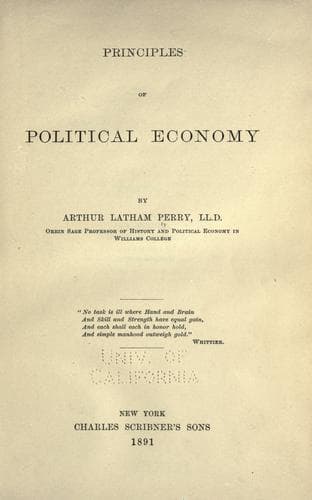
Principles of Political EconomyPerry, Arthur Latham
General
Principles of Political Economy
Perry, Arthur Latham
Economics
discriminate between customers urgent for and deserving of discounts,
and another class whose need of accommodation is not so sore, and a
third class who are sure to fail if the Panic stalks forward.
A permission given of the Government to the Bank of England to
overpass under these circumstances the Discount-limits laid down by
the Bank Act of 1844, has on three several occasions acted like a
charm to still the ragings of a commercial storm. On each of these
occasions, 1847, 1857, and 1866, the Bank was forbidden by the Privy
Council to discount for less than 10%.
As the inclined plane of rising prices is slowly ascended before a
Crisis, so the fall of general prices afterwards seems to be rather
gradual also till the lowest point of them is reached, from which
another ascent is apt to commence. The following table taken from the
_New York Public_ of the first week of November, 1881, is instructive
on both these points. Taking the prices in 1860 of 43 articles of
prime necessity, which constituted then and afterwards about 3/4 of
the commerce of the country, as the normal standard or 100, the table
gives the comparative gold prices of the same for four years previous
to 1873 and for seven years subsequent, as follows:--
1869 116
1870 118
1871 120
1872 122
1873 113
1874 115
1875 107
1876 100
1878 81
1879 98
1880 103
1881 111
(5) A penultimate Disadvantage of Credit may be noted in the facility
which it offers for contracting great national Debts. There are
certain aspects, under which a Nation may be properly regarded as a
moral person, and as such person may pledge the public faith for the
present and the future, becoming a debtor to its own people or to
foreigners, and thus a public debt may be made a sort of mortgage on
the national property and income. Now, it cannot be fairly denied,
that incidental advantages may spring up in connection with such a
national debt: for example, the bonds, which are its evidences, may
open up to the people a convenient form of investment for presently
inactive capital, and for trust funds of all kinds; there can be
little doubt that certain classes of persons holding these national
obligations are won thereby to a stronger patriotism and become better
friends to stability in government, although this consideration
applies mainly to new governments and to those temporarily endangered;
both England and the United States now make a portion of their public
debt the basis of a national system of Banking, but it is perhaps
questionable whether this can be justly put among the incidental
benefits of the Debts; and again "a moderate debt adds to the credit
of a Nation, and its ability to raise money in an emergency, for
bankers and capitalists are more ready to take such securities as they
are in the habit of dealing in" (Sidney Homer).
Public-domain text, read in full here on John Shaqi.
Reviews
Reviews
No reviews yet
Be the first to share your thoughts on this work.
Elsewhere in the archive
Join the Discussion
Join the discussion
Sign in to leave a comment or review.
Sign InorCreate an account