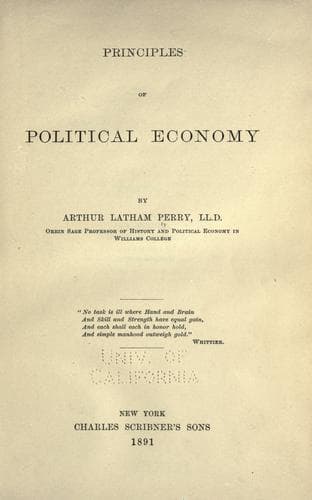
Principles of Political EconomyPerry, Arthur Latham
General
Principles of Political Economy
Perry, Arthur Latham
Economics
On the other hand, the burdens of a National Debt are very apparent:
for example, the annual _interest_ charge to the Union at the close of
our late civil war was $150,000,000, which gradually declined by the
lowering of the interest-rate and by the paying off of principal to
$61,368,912 for the fiscal year ending June 30, 1881; between March,
1869, and August, 1873, the United States paid $378,015,065 on the
principal of its public debt; the collection of the Internal Revenue
alone of the national government cost for the fiscal year 1867,
$7,712,089; and in each of the two years, 1870 and 1881, a little over
$101,500,000 was paid out to reduce the principal of the Debt. All
those vast sums came out of the industry and income of individuals;
and taxation to any degree as all this implies is a mighty disturbance
to industry, and gives rise to an army of officials who eat out a
considerable percentage of all they collect. Moreover, the various
expedients of taxation, which are always practically unequal in their
operation, are apt to give rise to irritation and political agitation,
and even sometimes to threats of repudiation, especially when the
occasion has gone by under which the debt was contracted, and another
generation is called upon to pay off a debt it had no agency in
creating.
Here the vexed question arises, how far has one generation _the right_
to throw upon succeeding ones the burdens of a National Debt? The true
answer to this question is, _it has a very limited right indeed_. The
opposite doctrine implies tacitly when not openly, that the succeeding
generations will have no occasion for extraordinary expenses of their
own, and, therefore, may rightfully be made to contribute to the
extraordinary expenditures of this generation. But it is pure
assumption to take for granted, that the next generations will not
have, of some kind or other, as much occasion for an extraordinary
effort in the way of defence or of improvement as the present
generation has had. It is a common but harmful illusion to estimate
what has now to be done as of much more importance than what will have
to be done. Therefore, to throw the present burden forward on another
generation of men, who are likely to have to make their own special
exertion, just as great and just as imperatively called for, is a
procedure unwarranted by past experience. The view that has long
prevailed in practice, that a great War-debt, for example, might be
easily and justly cast upon posterity, has again and again given rise
to needless and expensive wars; _those_ have been called upon to pay
the piper, who perceived the utter inutility of the expenditure; and
thus bitterness has been added to burden.
Public-domain text, read in full here on John Shaqi.
Reviews
Reviews
No reviews yet
Be the first to share your thoughts on this work.
Elsewhere in the archive
Join the Discussion
Join the discussion
Sign in to leave a comment or review.
Sign InorCreate an account