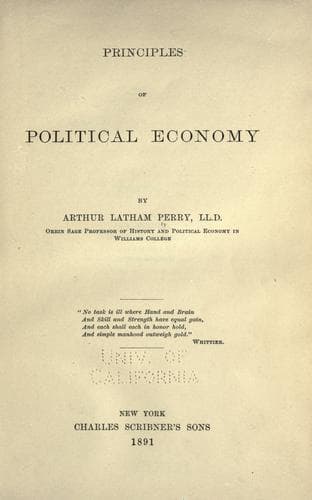
Principles of Political EconomyPerry, Arthur Latham
General
Principles of Political Economy
Perry, Arthur Latham
Economics
It is scarcely needful to add, that the Supreme Court of the United
States suffered in the judgment of good citizens by that transaction;
that the best legal and financial opinion of the country yielded
little respect to a decision _thus secured_; and that intelligent
people do not believe that constitutional law _can_ sanction what
contravenes at once common sense and common morality.
Judge Field (and his memory the country will not willingly let die),
one of the majority in the first decision, and writing the opinion of
the dissenting minority in the second, used this strong but just
language, "_It follows, then, logically, from the doctrine advanced by
the majority of the Court as to the power of Congress over the subject
of legal tender, that Congress may borrow gold coin upon a pledge to
repay gold at the maturity of its obligations, and yet in direct
disregard of its pledge, in open violation of faith, may compel the
lender to take, in place of the gold stipulated, its own promises; and
that legislation of this character would not be in violation of the
Constitution, but in harmony with its letter and spirit. What is this
but declaring that repudiation by the Government of the United States
of its solemn obligations would be Constitutional?_"
FOOTNOTES:
[7] John Jay Knox's United States Notes.
[8] Practical Political Economy, 1877, p. 452.
CHAPTER V.
MONEY.
The subject of Money presents few difficulties, or rather none of any
depth, to one who has thoroughly mastered the subject of Value. To all
others the difficulties are insuperable. Essay after essay and volume
after volume has been written in this country upon Money, by men who
would have become good economists and good monetaries, if they had
only begun their inquiries at the right place and followed them in the
right direction. As we saw in the last chapter that it is impossible
for anybody to understand the subject of Credit without first
comprehending the matter of Value, so we shall see in this chapter
that in the order of Nature Value precedes Money, and that the latter
can only be learned in the light of the former. The logical reason for
this in general is, that Money itself is always a Valuable, and comes
to its function as money only through a comparison of itself with
other Valuables.
The thin difficulties that confront the student of Money, who has
reached the topic along the proper highway cast up for economical
inquiries, arise apparently from two sources; and we will begin our
present discussion by first looking at these in their order.
Public-domain text, read in full here on John Shaqi.
Reviews
Reviews
No reviews yet
Be the first to share your thoughts on this work.
Elsewhere in the archive
Join the Discussion
Join the discussion
Sign in to leave a comment or review.
Sign InorCreate an account