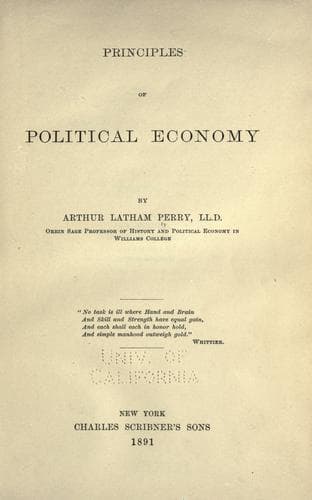
Principles of Political EconomyPerry, Arthur Latham
General
Principles of Political Economy
Perry, Arthur Latham
Economics
In the first place, Money is the only Valuable that may belong to two
out of the three possible categories into which Valuables may be
scientifically thrown. All Valuables are either Commodities, or
Services, or Credits. These categories never change places. Once a
Commodity always a commodity, so long as value can be predicate of it;
a personal Service can never take on any other valuable form; and a
Credit is ever a credit, and nothing else, until it is annihilated by
Fulfilment. Now Money is the only Valuable that ever appears in two of
these forms. The same Dollar indeed cannot be both a Commodity and a
Credit; but some Dollars are a Commodity cut out from gold and silver,
and some other Dollars (so-called) are a Credit issued by Government
or parties responsible to government; while Money as a general term
properly enough covers both kinds of Dollars, the Commodity-Dollar and
the Credit-Dollar. In other words, Money is of two kinds, and only two
kinds, either a Piece of valuable metal stamped as to weight and
fineness by the image and inscription of Cæsar,--a Commodity; or a
Promise to pay to somebody some of these pieces,--a Credit. This
unique peculiarity of Money, by which, always a Valuable, it may
appear and does appear in two out of three possible predicaments of
Valuables, makes a little difficulty at the outset of its discussion,
and requires continued care in formulating its scientific
propositions.
In the second place, a more considerable difficulty, and yet a slight
one still, is found in the fact that the choices and the legislations
of men have more to do in shaping the propositions of Money than in
most other economical propositions. It is true, that Nature and men
coöperate in the determination of every case of Value whatsoever;
while there is a difference in the cases, though perhaps not a
distinction, in respect to the fixedness and universality of the
natural laws involved, in contrariety to the purely human impulses
concerned. The Providential elements in Economics, both the social and
the physical, are of course relatively fixed and unchangeable,
otherwise Science could not grapple with and classify them; and so
also are those principles of Human Nature related to exchanges, which
may be said to be _universal_ in their character,--such as, for
example, the preference to receive a larger rather than a less
return-service, and to render a smaller rather than a larger effort;
and at the same time there are other principles of human nature
related to exchanges much more _variable_ in their character than
these, such, for instance, as the nation's choice of the kind of Money
it will use, or the kind of Taxation it will impose. It certainly
follows from this, that some Economical laws must be more _general_
than others, owing to a less variation in the human impulses concerned
in them: it follows, for example, that the law of landed rents, or the
law of the approach of the price of raw materials to that of the
Public-domain text, read in full here on John Shaqi.
Reviews
Reviews
No reviews yet
Be the first to share your thoughts on this work.
Elsewhere in the archive
Join the Discussion
Join the discussion
Sign in to leave a comment or review.
Sign InorCreate an account