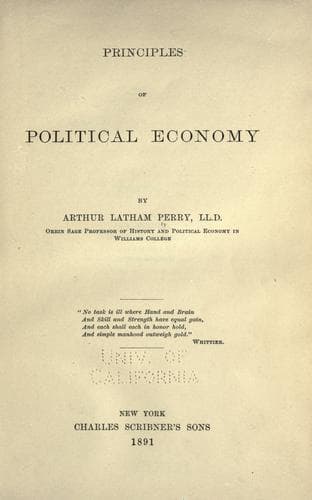
Principles of Political EconomyPerry, Arthur Latham
General
Principles of Political Economy
Perry, Arthur Latham
Economics
_But where is the "Value," of which we have been in search?_ The
answer is easy and certain and unevadible. _The Value is in the
Renderings, and nowhere else._ The value of the trowel is the wheat,
that is actually given in exchange for it; and the value of the wheat
is equally the trowel, for the sake of getting which the wheat was
rendered. What was the Value of King Hiram's cedar-timbers? The oil
and wheat actually returned in pay for them. What was the Value of the
oil and wheat sent northward by King Solomon? The timbers rendered in
direct exchange for the same. This is not merely the only possible
answer to the question, _What is Value?_ but it is also a perfectly
complete and satisfactory answer. Common language here corresponds
exactly with scientific language. "How much did the horse cost?" "One
hundred dollars." The dollars have nothing whatever in common with the
horse, except that they express his Value at the time; the horse has
nothing in common with the dollars, except that it expresses the Value
of the dollars at the time. It is just as exact to say, it means
precisely the same thing to say, the dollars are worth the horse, as
to say, the horse is worth the dollars.
In general terms, the Value of anything is something else received in
return for it, when each owner renders the one _for the sake of_
getting the other. This is the whole of it, so far as any specific
valuable thing is concerned. We shall indeed need after a little, and
shall have no trouble in finding, an abstract and universal definition
of "_Value_," as an abstract and scientific term perfectly
circumscribing the field of Economics. Here and now we are dealing
with the simpler concrete question, What is the value of any specific
valuable thing? The unvarying answer is, Some other specific valuable
thing already exchanged for the first! There may be expected value,
estimated value, but actual value there is none, until a real exchange
has settled how much the value is. The value of anything is something
else already exchanged for it. Value is not simply a relation
subsisting between two things, the result of a careful comparison
between them, but rather an actual fact established in connection with
them. The universal formula of Value is _quid pro quo_, in which
formula _quid_ stands for one of the valuables and _quo_ for the
other, and _pro_ unfolds the motive of each owner for the reciprocal
receiving and rendering.
Public-domain text, read in full here on John Shaqi.
Reviews
Reviews
No reviews yet
Be the first to share your thoughts on this work.
Join the Discussion
Join the discussion
Sign in to leave a comment or review.
Sign InorCreate an account