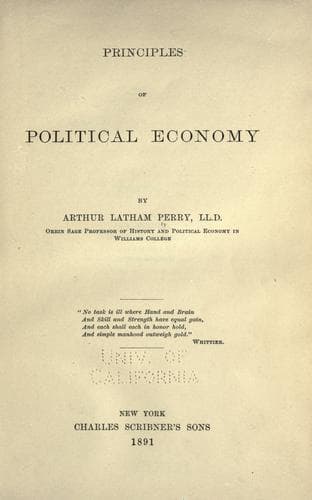
Principles of Political EconomyPerry, Arthur Latham
General
Principles of Political Economy
Perry, Arthur Latham
Economics
Here a caution is needful. Because nobody can tell what the value of
anything is until something else has been put over against it in order
to get it and actually received therefor, and because the only
possible way to express the value of either is in the terms of the
other,--the trowel is worth the wheat and the wheat is worth the
trowel,--one must not therefore jump to the conclusion that the value
of either is settled for all time or even for any future time. It is
only settled for _this_ time. In Economics as in Christianity, Now is
the accepted time. There is nothing fixed in Values, and never can be
from the nature of the case, because Desires are personal to
individuals, and Efforts fluctuate with times and persons, and
Estimates that wait on these vary from necessity, and the Renderings
of to-day may not be the chosen renderings of other persons in the
same articles to-morrow. Value is not a quality at all, still less is
it a permanent quality, of anything; it is a relation established
between two things when these are in the hands of two given persons;
but now when these are in the hands of two different persons, whose
views are pretty sure to differ from the former, and a new relation is
sought to be established between these in the old way of Estimates,
is it strange that a new balance is struck, and Value is expressed in
quite different terms?
One of the chief charms of Political Economy is the open secret, that
it deals not with rigidities and inflexible qualities and mathematical
quantities and the unchanging laws of matter, but with the billowy
play of desires and estimates and purposes and satisfactions, all of
which are mental states, and all of which are subject in the general
to ascertainable laws, though laws of a quite different kind from
those of Mechanics. Values come and they go. Within certain limits and
under certain conditions they may be anticipated and even predicted,
but never with the precision of an eclipse or the result of a known
chemical combination. There is a useful and fascinating Science of
Value, as we shall see indubitably by and by in the present chapter;
but it is a science that deals primarily with _persons_ and only
secondarily with _things_, with mind and not with matter, with the
general undulations of the sea and not with the crests of the waves.
And all this is so, because Values are relative, because the
announcements in the market-place to-day may stand listed differently
to-morrow and very differently next year, and because old values may
disappear altogether and many new ones come in, all in accordance with
the incessant changes in the wants and labors and fashions and
projects of men.
Public-domain text, read in full here on John Shaqi.
Reviews
Reviews
No reviews yet
Be the first to share your thoughts on this work.
Join the Discussion
Join the discussion
Sign in to leave a comment or review.
Sign InorCreate an account