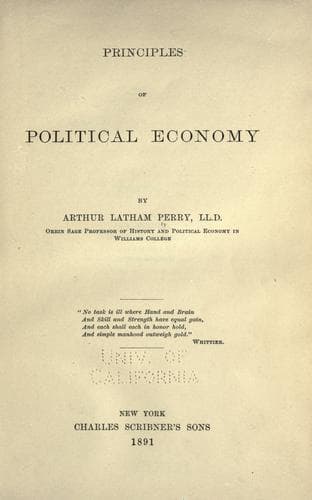
Principles of Political EconomyPerry, Arthur Latham
General
Principles of Political Economy
Perry, Arthur Latham
Economics
In the strictest sense, accordingly, there is no such thing as
physical labor, because the mental must coöperate with the physical
even in the lowest forms of human exertion; and in the same sense
there can be no such thing as exclusively mental labor, for the bodily
powers conspire more or less in the highest intellectual efforts that
are ever sold. Nevertheless, both the phrases, physical labor and
mental labor, are convenient and not harmful, whenever on the one side
the bodily powers seem to be predominant in the effort, and on the
other the intellectual.
It is now to be noticed, that all that men can do, when they labor
physically, is _to move something_. When a man works with his hands or
his feet or his whole body, all that he does or can do, is to begin a
series of motions or resistances to motion, for this good reason,
human muscles in their very structure are capable only of starting
motion and stopping motion. All the marvellous results of physical
effort in all the world have flowed from so simple a matter as the
contraction and expansion of muscle; and the world of materials is so
cunningly constructed, that, when these are moved into right position
by human hands, or by some form of capital itself the result of
previous human handling, the free powers of Nature do all the rest,
and valuable commodities are the good outcome. For one example, when
the woodman fells a tree for sale, he brings a series of motions
(_labor_) to bear upon the trunk, by means of his sharp axe
(_capital_), and then the power of gravitation (_nature_) seizes the
tree and brings it crashing to the earth. For a second illustration,
wool and cotton have by nature a certain tenacity of fibre, and what
is more to the point, a certain _kinkiness_ of fibre easily
interlinking one with another indefinitely in length; men move these
separate fibres in certain relations to each other by an instrument
(_capital_) called a spindle, and the result is thread; then other men
move these threads into relations with each other by means of an
implement (_capital_) called a shuttle, and the outcome is a web of
cloth; lastly, the tailor moves his shears through the cloth, and then
his needles, and the issue is a coat, a commodity, the valuable for
which all these processes were gone through with, and by the sale of
which all the onerous factors therein are compensated.
Public-domain text, read in full here on John Shaqi.
Reviews
Reviews
No reviews yet
Be the first to share your thoughts on this work.
Elsewhere in the archive
Join the Discussion
Join the discussion
Sign in to leave a comment or review.
Sign InorCreate an account