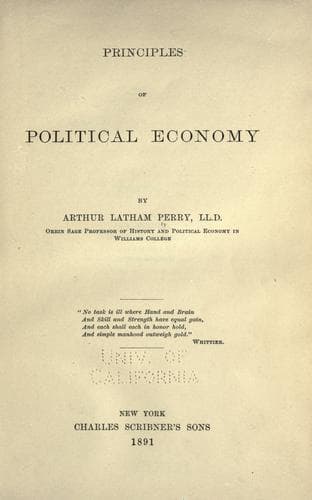
Principles of Political EconomyPerry, Arthur Latham
General
Principles of Political Economy
Perry, Arthur Latham
Economics
Now, since human muscles are soon wearied in action, and since motion
is the only thing required of men in the production of commodities,
they naturally look around for outside help in this matter; and the
first help they lighted on for moving things was the domestic animals,
the ox and ass and horse, doubtless domesticated in the very
beginnings of society; and as these can be used in so many different
places, and for such a variety of purposes, and are so cheaply reared,
they are exceedingly useful as a motive power, and will probably never
be superseded as such. Inanimate auxiliaries in moving things into
right position for the production of commodities, such as the
water-wheel and wind-mill, were undoubtedly brought into use much
later; and much later still, steam and electricity and other more
subtle and recondite natural agents. All of these helps, whether
animate or inanimate, do but cause simple motions of the same kind as
those caused by the human hand. The most ponderous engine merely
reduplicates that which the arm of a child is capable of; while in
point of delicacy and firmness of touch, perhaps no machinery can
subdivide and apply this motion so skilfully as the human fingers can.
It is said that some of the lace made wholly by hand is finer and more
delicate than any yet woven by machinery, although the introduction of
machinery into lace-making has cheapened lace products in general to a
small fraction of their former cost.
What we commonly call "_Power_," then, by whatever instrumentality
furnished, is simple auxiliary motion, additional to that of physical
human Labor. Commodities are produced in unlimited quantity and
variety by such labor, assisted by the free forces of nature applied
by means of animals and implements, which are capital. But such labor
is irksome as well as wearisome, and is never expended except in view
of a reward, which is secured only from the sale of the finished
commodity.
(c) Reserved Capital. We must examine the nature of Capital with care,
and follow its varied forms without confusion, because it is the only
other factor besides labor in the production of commodities, that has
to be paid for out of their sale.
Public-domain text, read in full here on John Shaqi.
Reviews
Reviews
No reviews yet
Be the first to share your thoughts on this work.
Elsewhere in the archive
Join the Discussion
Join the discussion
Sign in to leave a comment or review.
Sign InorCreate an account