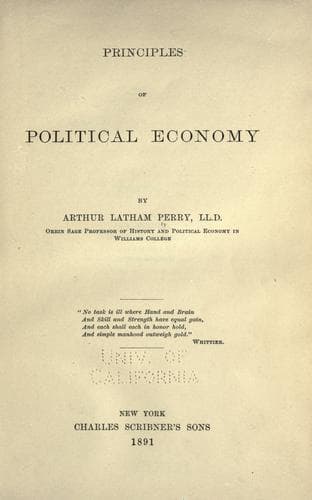
Principles of Political EconomyPerry, Arthur Latham
General
Principles of Political Economy
Perry, Arthur Latham
Economics
Simplest cases are always the best in economical discussions. Let us
take for illustration a recently observed case from the gold hills of
North Carolina. All the methods are strongly primitive, but all the
elements of production are present. A negro woman is the laborer, the
bits of gold scattered in the soil are the free gift of nature, a
bored log to divert the water from the mountain stream, and a tin pan
in which to gather and wash the sand and gravel, are two crude forms
of capital; free gravitation also brings the water through the log,
and free gravity carries down the particles of gold to the bottom of
the washing-pan, and many other agencies of free nature coöperate in
this very simple case of production; and besides the log and the pan,
there are doubtless some other forms of capital, at least the whittled
plug to stop at need the flow of water through the log. The chief
factor in these processes of production is still the laborer, the
motions of her hands in stirring the sand and picking out the precious
bits at the bottom of the pan are the chief motions, the labor is both
physical and mental,--no animal could be trained to adopt means to
ends like this negro woman.
It is her capital that now engages our attention. _Any Valuable
outside of man himself reserved to assist in the production of further
valuables is Capital._ The idea of growth and increase inheres in the
very word, which is derived from the Latin noun, _caput_, a head, a
source, and gives intimation in its etymology of its scientific
meaning. The word, _caput_, is often used in classical Latin for a sum
of money put out at interest, and its derivative, _capitale_, is also
used in the same sense, at least in mediæval Latin; and from this form
of the word have come into English not only _Capital_, but also by
corruption _Cattle_ and _Chattels_. Flocks and herds were at one time
the principal riches of our Saxon ancestors, and also the principal
means of _increasing_ their riches, and in process of time the same
root-word came to be spelled differently as applied to animate or
inanimate things of value; while the notion implied in the Latin
_caput_, and in the English _source_, came along in all three of these
words; and hence the careful definition of Capital above given.
Public-domain text, read in full here on John Shaqi.
Reviews
Reviews
No reviews yet
Be the first to share your thoughts on this work.
Elsewhere in the archive
Join the Discussion
Join the discussion
Sign in to leave a comment or review.
Sign InorCreate an account