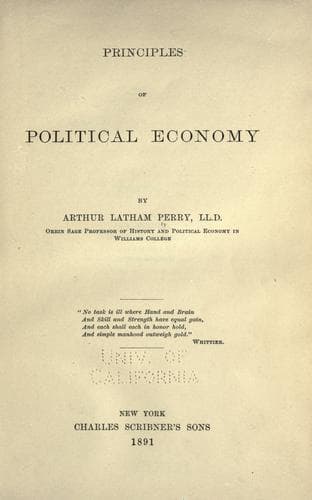
Principles of Political EconomyPerry, Arthur Latham
General
Principles of Political Economy
Perry, Arthur Latham
Economics
It makes no difference whether the colored woman bored her own log by
means of an item of capital already existing, namely, an auger, or
hired another person to bore it for her, or bought the log already
perforated, it is an article of Capital, a valuable kept to increase
future valuables; she might doubtless sell it for something to a
new-comer wishing to operate other sand in the neighborhood, but she
keeps it to help herself gather more gold for ultimate sale, she
practises what we call in Economics _abstinence_ and must have her
reward for this in the form of _profits_ from the ultimate sale of her
commodity, gold, as well as a reward for her labor in the form of
_wages_ from the same source. As one person furnishes both the labor
and capital in this case, there is no actual division of the gross
return into wages and profits, as there always must be when separate
parties furnish the two essential factors, both of which must be
remunerated by the sale of the commodity. What is thus true of the
log, is equally true of the tin-pan, and even of the plug also, if it
be capable of repeated use and cost something of labor and the help of
a previous item of capital, namely, the jack-knife. Our negro woman of
the South is a small capitalist as well as a rude laborer, and
practises _abstinence_ as well as puts forth _exertion_, and
consequently is entitled to receive _profits_ as well as _wages_ in
the return she gets for her gold-dust when she sells it.
We are now beginning to see what the nature of Capital is, and what
the motives are for employing it. In the production of commodities
Capital is always something that makes easier to the producers the
getting ready to sell and the selling of future commodities. The
capital always spares more or less of onerous and irksome human
exertion. It always mediates between some free force of Nature and
some otherwise more onerous effort of men. The sole motive to employ
capital in any one or in all of its multitudinous forms from the
simplest to the most complex is to throw off upon the ever-willing
shoulders of Nature some part of the irksome effort that would
otherwise come to the easily-wearied muscles of men. Nature is "good,"
to use a commercial term, for all she can be made to carry of men's
work, through implements devised and machinery contrived to apply, to
commodities in every stage of their transformation and transportation
till the last, the ever-present potencies of this physical world.
These potencies cost nothing. The implements and machinery cost much
in present labor and previously created capital. The ultimate sale of
commodities must make return for all the forms of capital employed in
their production, in the shape of Profits, the reward of
_abstinence_; and for all the forms of direct labor employed in their
production, in the shape of Wages, the reward of personal _effort_.
Public-domain text, read in full here on John Shaqi.
Reviews
Reviews
No reviews yet
Be the first to share your thoughts on this work.
Elsewhere in the archive
Join the Discussion
Join the discussion
Sign in to leave a comment or review.
Sign InorCreate an account