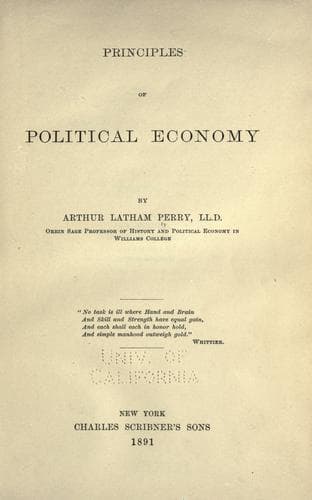
Principles of Political EconomyPerry, Arthur Latham
General
Principles of Political Economy
Perry, Arthur Latham
Economics
The beaver gnaws down the tree with his teeth from generation to
generation in precisely the same manner; but man is a being more nobly
endowed than the beaver, and no sooner had he occasion to fell trees,
than something of the nature of an axe suggested itself to his
ingenuity. It is true, that his earliest attempts at axe-making were
probably of the rudest sort, but just as soon as anything was devised,
whether of flint or shell or metal, that rendered easier the felling
of a tree, Capital made a beginning along that line of obstacles. Our
chief interest in studying the implements of the successive so-called
Ages of Stone and Bronze and Iron, is to witness the increasing
degrees of ingenuity displayed by those pre-historic men. Among the
more gifted races, progress in this direction was perhaps more rapid
than we are wont to think it was, since Tubal-Cain, the first
artificer of record, is said to have "_hammered all kinds of
implements out of copper and iron_" (Gen. iv, 22). Lucretius, writing
in the century before the Christian era, put down the following lines
in vigorous Latin, as translated by Mason Good:--
"Man's earliest arms were fingers, teeth, and nails,
And stones, and fragments from the branching woods;
Then copper next; and last, as later traced,
The tyrant iron."
We are at no loss, then, to explain the origin of Capital and its
motives. Tools are invented and employed for no other reason than
this, that, by means of their help, the human efforts are lessened
relatively to the given satisfactions. Since it requires tools to make
tools, the progress of this branch of capital must have been
relatively slow at first; but, since every advance in mechanical
contrivance makes still further advances easier, there is a natural
tendency, which facts abundantly exemplify, to a more and more rapid
progression in the number and perfection of all implements of
production. The same motive that impelled to the first invention, has
impelled to the whole series of inventions since, and will constantly
impel to further inventions till the end of time. Every step of this
progress gives birth to a larger and still larger proportion of
satisfactions relatively to efforts; marks an increasing control on
the part of man over the powers of Nature; and gives promise for the
time to come of greater advantages still in both of these directions.
The powers of Nature, such as those which make the grain grow, bring
the tree down, turn the water-wheel, impel the locomotive, and send
the message round the world, all stand ready to slave in the service
of man; but in order to make their aid available for human purposes,
there must be a plough, an axe, a wheel, an engine, an electric
machine; and it is because capital brings gratuitous natural forces
into service, and the more so as capital progresses, that the Value of
those commodities produced by the aid of capital tends constantly to
Public-domain text, read in full here on John Shaqi.
Reviews
Reviews
No reviews yet
Be the first to share your thoughts on this work.
Elsewhere in the archive
Join the Discussion
Join the discussion
Sign in to leave a comment or review.
Sign InorCreate an account