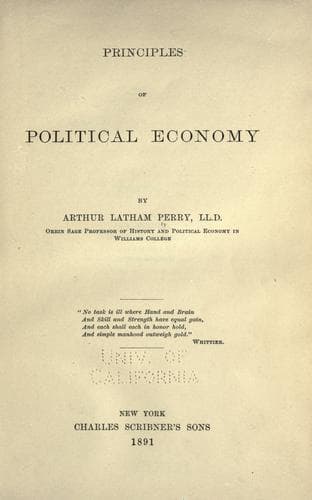
Principles of Political EconomyPerry, Arthur Latham
General
Principles of Political Economy
Perry, Arthur Latham
Economics
decline as compared with those commodities, in the production of which
capital conspires less.
It is already plain, that the class, Capital, is a smaller and a
peculiar sub-class under the great class, Valuables; nothing can
become Capital until it first become a Valuable, and then be
_capitalized_ by a distinct act or intention on the part of the owner
to reserve it in his own hands as an aid in further production, or
transfer it to other hands to be so used, he meanwhile receiving
profits as the reward of his abstinence; only a _transferable_
valuable, accordingly, can become Capital in any case, that is to say,
it must be either a Commodity or a Credit, since personal services,
though they may be sold, cannot be put over into the hands of another
to be used in production, and therefore cannot become Capital in any
case; and the chief peculiarity of this sub-class, Capital, is, unlike
the three great classes of Valuables, each of which is utterly
distinct from the other two, so that a Commodity can never become a
Credit or a personal Service either of the others, that Capital as a
class has extremely flexible limits, and consequently certain
Commodities and Credits may easily enough be Capital to-day, and fall
back to-morrow into their respective classes of mere Valuables and the
next day come out from the class Non-Capital into the class Capital
again. The same commodities and credits may be capital at one time,
and non-capital at another, though they must be valuable all the time,
or cease to be commodities and credits. When it is said that a young
man's talents and skill are his "capital," the word of course is used
in a metaphorical sense, and the meaning is, that skill and talents
are _like_ capital in some respects. Popular language is not
scientific.
Public-domain text, read in full here on John Shaqi.
Reviews
Reviews
No reviews yet
Be the first to share your thoughts on this work.
Elsewhere in the archive
Join the Discussion
Join the discussion
Sign in to leave a comment or review.
Sign InorCreate an account