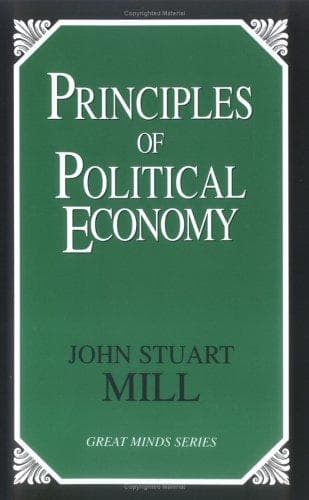
Principles of Political Economy: Abridged with Critical, Bibliographical, and Explanatory Notes, and a Sketch of the History of Political EconomyMill, John Stuart
PhilosophyPhilosophy
Principles of Political Economy: Abridged with Critical, Bibliographical, and Explanatory Notes, and a Sketch of the History of Political Economy
Mill, John Stuart
Economics
It is worth notice that the first glimmerings of political economy came to
be seen through the discussions on money, and the extraordinary movements
of gold and silver. About the time of Charles V, the young study was born,
accompanied by the revival of learning, the Reformation, the discovery of
America, and the great fall in the value of gold and silver. Modern
society was just beginning, and had already brought manufactures into
existence—woolens in England, silks in France, Genoa, and Florence; Venice
had become the great commercial city of the world; the Hanseatic League
was carrying goods from the Mediterranean to the Baltic; and the Jews of
Lombardy had by that time brought into use the bill of exchange. While the
supply of the precious metals had been tolerably constant hitherto, the
steady increase of business brought about a fall of prices. From the
middle of the fourteenth to the end of the fifteenth century the
purchasing power of money increased in the ratio of four to ten. Then into
this situation came the great influx of gold and silver from the New
World. Prices rose unequally; the trading and manufacturing classes were
flourishing, while others were depressed. In the sixteenth century the
price of wheat tripled, but wages only doubled; the laboring-classes of
England deteriorated, while others were enriched, producing profound
social changes and the well-known flood of pauperism, together with the
rise of the mercantile classes. Then new channels of trade were opened to
the East and West. Of course, men saw but dimly the operation of these
economic causes; although the books now began to hint at the right
understanding of the movements and the true laws of money.
Even before this time, however, Nicole Orêsme, Bishop of Lisieux (died
1382), had written intelligently on money;(4) but, about 1526, the
astronomer Copernicus gave a very good exposition of some of the functions
of money. But he, as well as Latimer,(5) while noticing the economic
changes, gave no correct explanation. The Seigneur de Malestroit, a
councilor of the King of France, however, by his errors drew out Jean
Bodin(6) to say that the rise of prices was due to the abundance of money
brought from America. But he was in advance of his time, as well as
William Stafford,(7) the author of the first English treatise on money,
which showed a perfect insight into the subject. Stafford distinctly
grasped the idea that the high prices brought no loss to merchants, great
gain to those who held long leases, and loss to those who did not buy and
sell; that, in reality, commodities were exchanged when money was passed
from hand to hand.
Public-domain text, read in full here on John Shaqi.
Reviews
Reviews
No reviews yet
Be the first to share your thoughts on this work.
Join the Discussion
Join the discussion
Sign in to leave a comment or review.
Sign InorCreate an account