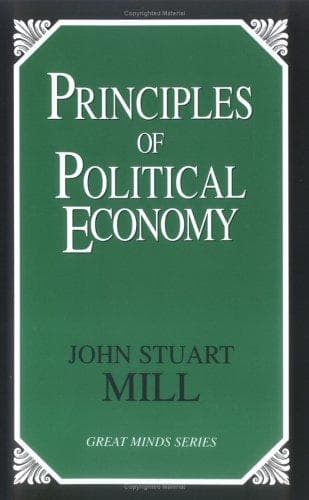
Principles of Political Economy: Abridged with Critical, Bibliographical, and Explanatory Notes, and a Sketch of the History of Political EconomyMill, John Stuart
PhilosophyPhilosophy
Principles of Political Economy: Abridged with Critical, Bibliographical, and Explanatory Notes, and a Sketch of the History of Political Economy
Mill, John Stuart
Economics
GENERAL BIBLIOGRAPHY.—There is no satisfactory general history of
political economy in English. Blanqui’s “Histoire de l’économie
politique en Europe” (Paris, 1837) is disproportioned and
superficial, and he labors under the disadvantage of not
understanding the English school of economists. He studies to give
the history of economic facts, rather than of economic laws. The
book has been translated into English (New York, 1880).
Villeneuve-Bargemont, in his “Histoire de l’économie politique”
(Paris, 1841), aims to oppose a “Christian political economy” to
the “English” political economy, and indulges in religious
discussions.
Travers Twiss, “View of the Progress of Political Economy in
Europe since the Sixteenth Century” (London, 1847), marked an
advance by treating the subject in the last four centuries, and by
separating the history of principles from the history of facts. It
is brief, and only a sketch. Julius Kautz has published in German
the best existing history, “Die geschichtliche Entwickelung der
National-Oekonomie und ihrer Literatur” (Vienna, 1860). (See
Cossa, “Guide to the Study of Political Economy,” page 80.) Cossa
in his book has furnished a vast amount of information about
writers, classified by epochs and countries, and a valuable
discussion of the divisions of political economy by various
writers, and its relation to other sciences. It is a very
desirable little hand-book. McCulloch, in his “Introduction to the
Wealth of Nations,” gives a brief sketch of the growth of economic
doctrine. The editor begs to acknowledge his great indebtedness
for information to his colleague, Professor Charles F. Dunbar, of
Harvard University.
Systematic study for an understanding of the laws of political economy is
to be found no farther back than the sixteenth century. The history of
political economy is not the history of economic institutions, any more
than the history of mathematics is the history of every object possessing
length, breadth, and thickness. Economic history is the story of the
gradual evolution in the thought of men of an understanding of the laws
which to-day constitute the science we are studying. It is essentially
modern.(1)
Aristotle(2) and Xenophon had some comprehension of the theory of money,
and Plato(3) had defined its functions with some accuracy. The economic
laws of the Romans were all summed up in the idea of enriching the
metropolis at the expense of the dependencies. During the middle ages no
systematic study was undertaken, and the nature of economic laws was not
even suspected.
Public-domain text, read in full here on John Shaqi.
Reviews
Reviews
No reviews yet
Be the first to share your thoughts on this work.
Join the Discussion
Join the discussion
Sign in to leave a comment or review.
Sign InorCreate an account