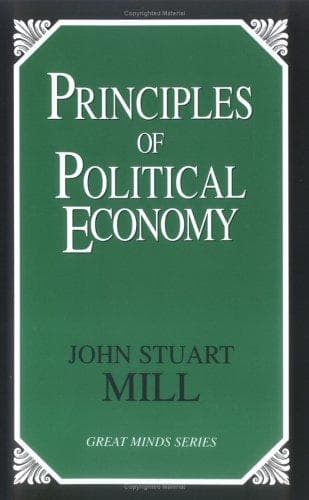
Principles of Political Economy: Abridged with Critical, Bibliographical, and Explanatory Notes, and a Sketch of the History of Political EconomyMill, John Stuart
PhilosophyPhilosophy
Principles of Political Economy: Abridged with Critical, Bibliographical, and Explanatory Notes, and a Sketch of the History of Political Economy
Mill, John Stuart
Economics
An exposition of mercantilism would not be complete without a statement of
the form it assumed in France under the guidance of Colbert,(14) the great
minister of Louis XIV, from 1661 to 1683. In order to create a favorable
balance of trade, he devoted himself to fostering home productions, by
attempts to abolish vexatious tolls and customs within the country, and by
an extraordinary system of supervision in manufacturing establishments
(which has been the stimulus to paternal government from which France has
never since been able to free herself). Processes were borrowed from
England, Germany, and Sweden, and new establishments for making tapestries
and silk goods sprang up; even the sizes of fabrics were regulated by
Colbert, and looms unsuitable for these sizes destroyed. In 1671
wool-dyers were given a code of detailed instructions as to the processes
and materials that might be used. Long after, French industry felt the
difficulty of struggling with stereotyped processes. His system, however,
naturally resulted in a series of tariff measures (in 1664 and 1667).
Moderate duties on the exportation of raw materials were first laid on,
followed by heavy customs imposed on the importation of foreign goods. The
shipment of coin was forbidden; but Colbert’s criterion of prosperity was
the favorable balance of trade. French agriculture was overlooked. The
tariff of 1667 was based on the theory that foreigners must of necessity
buy French wines, lace, and wheat; that the French could sell, but not
buy; but the act of 1667 cut off the demand for French goods, and
Portuguese wines came into the market. England and Holland retaliated and
shut off the foreign markets from France. The wine and wheat growers of
the latter country were ruined, and the rural population came to the verge
of starvation. Colbert’s last years were full of misfortune and
disappointment; and a new illustration was given of the fallacy that the
gain from international trade was not mutual.
Public-domain text, read in full here on John Shaqi.
Reviews
Reviews
No reviews yet
Be the first to share your thoughts on this work.
Join the Discussion
Join the discussion
Sign in to leave a comment or review.
Sign InorCreate an account