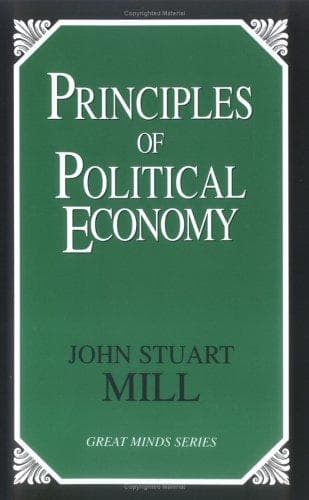
Principles of Political Economy: Abridged with Critical, Bibliographical, and Explanatory Notes, and a Sketch of the History of Political EconomyMill, John Stuart
PhilosophyPhilosophy
Principles of Political Economy: Abridged with Critical, Bibliographical, and Explanatory Notes, and a Sketch of the History of Political Economy
Mill, John Stuart
Economics
From this time, economic principles began to be better apprehended. It is
to be noted that the first just observations arose from discussions upon
money, and thence upon international trade. So far England has furnished
the most acute writers: now France became the scene of a new movement.
Marshal Vauban,(15) the great soldier, and Boisguillebert(16) both began
to emphasize the truth that wealth really consists, not in money alone,
but in an abundance of commodities; that countries which have plenty of
gold and silver are not wealthier than others, and that money is only a
medium of exchange. It was not, however, until 1750 that evidences of any
real advance began to appear; for Law’s famous scheme (1716-1720) only
served as a drag upon the growth of economic truth. But in the middle of
the eighteenth century an intellectual revival set in: the “Encyclopædia”
was published, Montesquieu wrote his “l’Ésprit des Lois,” Rousseau was
beginning to write, and Voltaire was at the height of his power. In this
movement political economy had an important share, and there resulted the
first school of Economists, termed the Physiocrats.
The founder and leader of this new body of economic thinkers was François
Quesnay,(17) a physician and favorite at the court of Louis XV. Passing by
his ethical basis of a natural order of society, and natural rights of
man, his main doctrine, in brief, was that the cultivation of the soil was
the only source of wealth; that labor in other industries was sterile; and
that freedom of trade was a necessary condition of healthy distribution.
While known as the “Economists,” they were also called the
“Physiocrats,”(18) or the “Agricultural School.” Quesnay and his followers
distinguished between the creation of wealth (which could only come from
the soil) and the union of these materials, once created, by labor in
other occupations. In the latter case the laborer did not, in their
theory, produce wealth. A natural consequence of this view appeared in a
rule of taxation, by which all the burdens of state expenditure were laid
upon the landed proprietors alone, since they alone received a surplus of
wealth (the famous _net produit_) above their sustenance and expenses of
production. This position, of course, did not recognize the old mercantile
theory that foreign commerce enriched a nation solely by increasing the
quantity of money. To a physiocrat the wealth of a community was increased
not by money, but by an abundant produce from its own soil. In fact,
Quesnay argued that the right of property included the right to dispose of
it freely at home or abroad, unrestricted by the state. This doctrine was
formulated in the familiar expression, “_Laissez faire, laissez
passer_.”(19) Condorcet and Condillac favored the new ideas. The
“Economists” became the fashion in France; and even included in their
number Joseph II of Austria, the Kings of Spain, Poland, Sweden, Naples,
Public-domain text, read in full here on John Shaqi.
Reviews
Reviews
No reviews yet
Be the first to share your thoughts on this work.
Join the Discussion
Join the discussion
Sign in to leave a comment or review.
Sign InorCreate an account