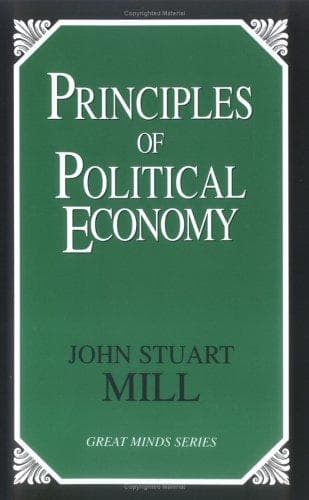
Principles of Political Economy: Abridged with Critical, Bibliographical, and Explanatory Notes, and a Sketch of the History of Political EconomyMill, John Stuart
PhilosophyPhilosophy
Principles of Political Economy: Abridged with Critical, Bibliographical, and Explanatory Notes, and a Sketch of the History of Political Economy
Mill, John Stuart
Economics
“I believe that, in the existing state of the national wealth, the
character of Englishmen being what it is, a certain prospect of
profit will ‘determine’ a certain proportion of this wealth to
productive investment; that the amount thus ‘determined’ will
increase as the field for investment is extended, and that it will
not increase beyond what this field can find employment for at
that rate of profit which satisfies English commercial
expectation. Further, I believe that, investment thus taking
place, the form which it shall assume will be ‘determined’ by the
nature of the national industries—‘determined,’ not under acts of
Parliament, or in virtue of any physical law, but through the
influence of the investor’s interests; while this, the form of the
investment, will again ‘determine’ the proportion of the whole
capital which shall be paid as wages to laborers.”(166) In this
excellent and masterly conception, the doctrine of a wages-fund is
not open to the objections usually urged against it. Indeed, with
the exception of Professor Fawcett, scarcely any economist
believes in an absolutely fixed wages-fund. In this sense, then,
and in view of the above explanation, it will be understood what
is meant by saying that wages depend upon the proportion of the
wages-fund to the number of the wage-receivers.(167)
In applying these principles to the question of strikes, it is
evident enough that if they result in an actual expansion of the
whole circle B, by forcing saving from unproductive expenditure, a
real addition, of some extent, may be made to the wages-fund; but
only by increasing the total capital. If, however, they attempt to
increase one of the elements of capital, the wages-fund, without
also adding to the other elements, fixed capital and materials, in
the proportion fixed by the nature of the industry, they will
destroy all possibility of continuing that production in the
normal way, and the capitalist must withdraw from the enterprise.
Public-domain text, read in full here on John Shaqi.
Reviews
Reviews
No reviews yet
Be the first to share your thoughts on this work.
Elsewhere in the archive
Join the Discussion
Join the discussion
Sign in to leave a comment or review.
Sign InorCreate an account