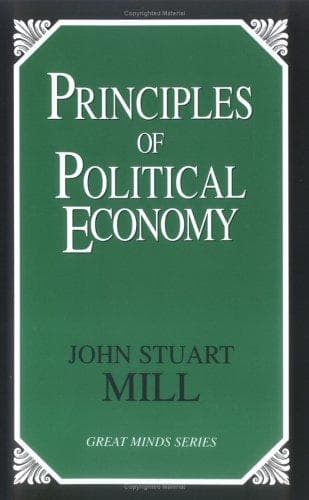
Principles of Political Economy: Abridged with Critical, Bibliographical, and Explanatory Notes, and a Sketch of the History of Political EconomyMill, John Stuart
PhilosophyPhilosophy
Principles of Political Economy: Abridged with Critical, Bibliographical, and Explanatory Notes, and a Sketch of the History of Political Economy
Mill, John Stuart
Economics
Francis A. Walker(168) has also offered a solution of this problem
in his “Wages Question” (1876), in which he holds that “wages are,
in a philosophical view of the subject, paid out of the product of
present industry, and hence that production furnishes the true
measure of wages” (p. 128). “It is the prospect of a profit in
production which determines the employer to hire laborers; it is
the anticipated value of the product which determines how much he
can pay him” (p. 144). No doubt wages _can_ be (and often are)
paid out of the current product; but _what_ amount? What is the
principle of distribution? Wherever the incoming product is a
moral certainty (and, unless this is true, in no case could wages
be paid out of the future product), saving is as effective upon it
as upon the actual accumulations of the past; and the amount of
the coming product which will be saved and used as capital is
determined by the same principles which govern the saving of past
products. An increase of circle A by a larger production makes
possible an increase of circle B, but whether it will be enlarged
or not depends on the principle of accumulation. The larger the
total production of wealth, the greater the _possible_ wages, all
must admit; but it does not seem clear that General Walker has
given us a solution of the real question at issue. The larger the
house you build, the larger the rooms may be; but it does not
follow that the rooms will be necessarily large—as any inmate of a
summer hotel will testify.
§ 3. Examination of some popular Opinions respecting Wages.
There are, however, some facts in apparent contradiction to this [the
Wages-Fund] doctrine, which it is incumbent on us to consider and explain.
Public-domain text, read in full here on John Shaqi.
Reviews
Reviews
No reviews yet
Be the first to share your thoughts on this work.
Elsewhere in the archive
Join the Discussion
Join the discussion
Sign in to leave a comment or review.
Sign InorCreate an account