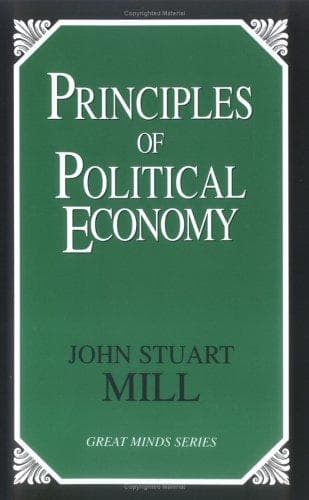
Principles of Political Economy: Abridged with Critical, Bibliographical, and Explanatory Notes, and a Sketch of the History of Political EconomyMill, John Stuart
PhilosophyPhilosophy
Principles of Political Economy: Abridged with Critical, Bibliographical, and Explanatory Notes, and a Sketch of the History of Political Economy
Mill, John Stuart
Economics
1. For instance, it is a common saying that wages are high when trade is
good. The demand for labor in any particular employment is more pressing,
and higher wages are paid, when there is a brisk demand for the commodity
produced; and the contrary when there is what is called a stagnation: then
work-people are dismissed, and those who are retained must submit to a
reduction of wages; though in these cases there is neither more nor less
capital than before. This is true; and is one of those complications in
the concrete phenomena which obscure and disguise the operation of general
causes; but it is not really inconsistent with the principles laid down.
Capital which the owner does not employ in purchasing labor, but keeps
idle in his hands, is the same thing to the laborers, for the time being,
as if it did not exist. All capital is, from the variations of trade,
occasionally in this state. A manufacturer, finding a slack demand for his
commodity, forbears to employ laborers in increasing a stock which he
finds it difficult to dispose of; or if he goes on until all his capital
is locked up in unsold goods, then at least he must of necessity pause
until he can get paid for some of them. But no one expects either of these
states to be permanent; if he did, he would at the first opportunity
remove his capital to some other occupation, in which it would still
continue to employ labor. The capital remains unemployed for a time,
during which the labor market is overstocked, and wages fall. Afterward
the demand revives, and perhaps becomes unusually brisk, enabling the
manufacturer to sell his commodity even faster than he can produce it; his
whole capital is then brought into complete efficiency, and, if he is
able, he borrows capital in addition, which would otherwise have gone into
some other employment. These, however, are but temporary fluctuations: the
capital now lying idle will next year be in active employment, that which
is this year unable to keep up with the demand will in its turn be locked
up in crowded warehouses; and wages in these several departments will ebb
and flow accordingly: but nothing can permanently alter general wages,
except an increase or a diminution of capital itself (always meaning by
the term, the funds of all sorts, destined for the payment of labor)
compared with the quantity of labor offering itself to be hired.
Public-domain text, read in full here on John Shaqi.
Reviews
Reviews
No reviews yet
Be the first to share your thoughts on this work.
Elsewhere in the archive
Join the Discussion
Join the discussion
Sign in to leave a comment or review.
Sign InorCreate an account