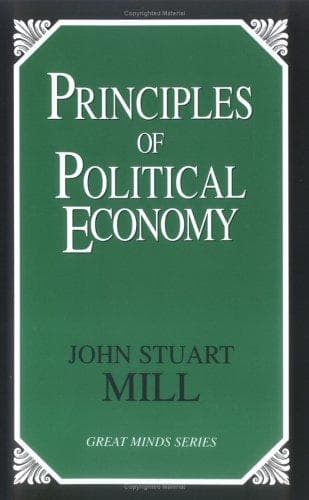
Principles of Political Economy: Abridged with Critical, Bibliographical, and Explanatory Notes, and a Sketch of the History of Political EconomyMill, John Stuart
PhilosophyPhilosophy
Principles of Political Economy: Abridged with Critical, Bibliographical, and Explanatory Notes, and a Sketch of the History of Political Economy
Mill, John Stuart
Economics
2. Again, it is another common notion that high prices make high wages;
because the producers and dealers, being better off, can afford to pay
more to their laborers. I have already said that a brisk demand, which
causes temporary high prices, causes also temporary high wages. But high
prices, in themselves, can only raise wages if the dealers, receiving
more, are induced to save more, and make an addition to their capital, or
at least to their purchases of labor. Wages will probably be temporarily
higher in the employment in which prices have risen, and somewhat lower in
other employments: in which case, while the first half of the phenomenon
excites notice, the other is generally overlooked, or, if observed, is not
ascribed to the cause which really produced it. Nor will the partial rise
of wages last long: for, though the dealers in that one employment gain
more, it does not follow that there is room to employ a greater amount of
savings in their own business: their increasing capital will probably flow
over into other employments, and there counterbalance the diminution
previously made in the demand for labor by the diminished savings of other
classes.
A clear distinction must be made between real wages and money
wages; the former is of importance to the laborer as being his
real receipts. The quantity of commodities satisfying his desires
which the laborer receives for his exertion constitutes his real
wages. The mere amount of money he receives for his exertions,
irrespective of what the money will exchange for, forms his money
wages. Since the functions of money have not yet been explained,
it is difficult to discuss the relation between prices and money
wages here. But, as the total value of the products in a certain
industry is the sum out of which both money wages and profits are
paid, this total will rise or fall (efficiency of labor remaining
the same) with the price of the particular article. If the price
rises, profits will be greater than elsewhere, and more capital
will be invested in that one business; that is, the capital will
be a demand for more labor, and, until equalization is
accomplished in all trades between wages and profits, money wages
will be higher in some trades than in others.(169)
Public-domain text, read in full here on John Shaqi.
Reviews
Reviews
No reviews yet
Be the first to share your thoughts on this work.
Elsewhere in the archive
Join the Discussion
Join the discussion
Sign in to leave a comment or review.
Sign InorCreate an account