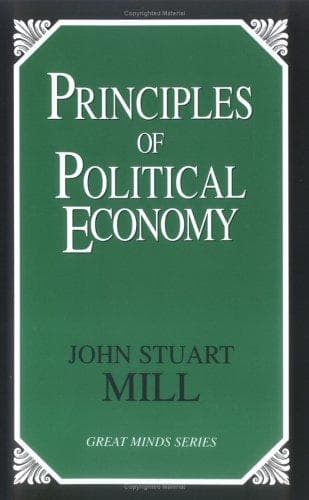
Principles of Political Economy: Abridged with Critical, Bibliographical, and Explanatory Notes, and a Sketch of the History of Political EconomyMill, John Stuart
PhilosophyPhilosophy
Principles of Political Economy: Abridged with Critical, Bibliographical, and Explanatory Notes, and a Sketch of the History of Political Economy
Mill, John Stuart
Economics
I ask, then, is it true or not, that if their numbers were fewer they
would obtain higher wages? This is the question, and no other: and it is
idle to divert attention from it, by attacking any incidental position of
Malthus or some other writer, and pretending that to refute that is to
disprove the principle of population. Some, for instance, have achieved an
easy victory over a passing remark of Mr. Malthus, hazarded chiefly by way
of illustration, that the increase of food may perhaps be assumed to take
place in an arithmetical ratio, while population increases in a
geometrical: when every candid reader knows that Mr. Malthus laid no
stress on this unlucky attempt to give numerical precision to things which
do not admit of it, and every person capable of reasoning must see that it
is wholly superfluous to his argument. Others have attached immense
importance to a correction which more recent political economists have
made in the mere language of the earlier followers of Mr. Malthus. Several
writers had said that it is the tendency of population to _increase
faster_ than the means of subsistence. The assertion was true in the sense
in which they meant it, namely, that population would in most
circumstances increase faster than the means of subsistence, if it were
not checked either by mortality or by prudence. But inasmuch as these
checks act with unequal force at different times and places, it was
possible to interpret the language of these writers as if they had meant
that population is usually gaining ground upon subsistence, and the
poverty of the people becoming greater. Under this interpretation of their
meaning, it was urged that the reverse is the truth: that as civilization
advances, the prudential check tends to become stronger, and population to
slacken its rate of increase, relatively to subsistence; and that it is an
error to maintain that population, in any improving community, tends to
increase faster than, or even so fast as, subsistence.(171) The word
tendency(172) is here used in a totally different sense from that of the
writers who affirmed the proposition; but waiving the verbal question, is
it not allowed, on both sides, that in old countries population presses
too closely upon the means of subsistence?
Chapter III. Of Remedies For Low Wages.
§ 1. A Legal or Customary Minimum of Wages, with a Guarantee of
Employment.
Public-domain text, read in full here on John Shaqi.
Reviews
Reviews
No reviews yet
Be the first to share your thoughts on this work.
Elsewhere in the archive
Join the Discussion
Join the discussion
Sign in to leave a comment or review.
Sign InorCreate an account