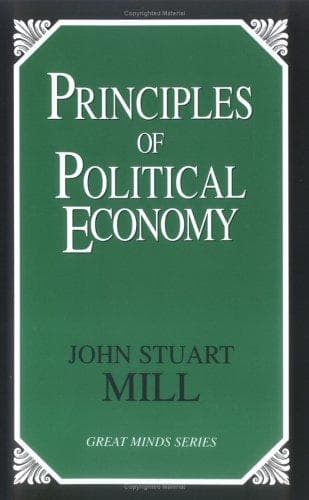
Principles of Political Economy: Abridged with Critical, Bibliographical, and Explanatory Notes, and a Sketch of the History of Political EconomyMill, John Stuart
PhilosophyPhilosophy
Principles of Political Economy: Abridged with Critical, Bibliographical, and Explanatory Notes, and a Sketch of the History of Political Economy
Mill, John Stuart
Economics
The simplest expedient which can be imagined for keeping the wages of
labor up to the desirable point would be to fix them by law; and this is
virtually the object aimed at in a variety of plans which have at
different times been, or still are, current, for remodeling the relation
between laborers and employers. No one, probably, ever suggested that
wages should be absolutely fixed, since the interests of all concerned
often require that they should be variable; but some have proposed to fix
a minimum of wages, leaving the variations above that point to be adjusted
by competition. Another plan, which has found many advocates among the
leaders of the operatives, is that councils should be formed, which in
England have been called local boards of trade, in France “conseils de
prud’hommes,” and other names; consisting of delegates from the
work-people and from the employers, who, meeting in conference, should
agree upon a rate of wages, and promulgate it from authority, to be
binding generally on employers and workmen; the ground of decision being,
not the state of the labor market, but natural equity; to provide that the
workmen shall have _reasonable_ wages, and the capitalist reasonable
profits.
The one expedient most suggested by politicians and
labor-reformers in the United States is an eight-hour law,
mandatory upon all employers. It is to be remembered, however,
that in very many industries piece-work exists, and if a
diminution of hours is enforced, that will mean a serious
reduction in the amount of wages which can be possibly earned in a
day. Even if all industries were alike in the matter of arranging
their work, this plan means higher wages for the same work, or the
same wages for less work, and so an increased cost of labor. This
would, then, take its effect on profits at once; and the effects
would be probably seen in a withdrawal of capital from many
industries, where, as now, the profits are very low. It must be
recalled, however, that in the United States there has been, under
the influence of natural causes, unaided by legislation, a very
marked reduction in the hours of labor, accompanied by an increase
of wages. For example, in 1840, Rhode Island operatives in the
carding-room of the cotton-mills worked fourteen hours a day for
$3.28 a week, while in 1884 they work eleven hours and receive
$5.40 a week. This result is most probably due to the gain arising
from the invention of labor-saving machinery.
Public-domain text, read in full here on John Shaqi.
Reviews
Reviews
No reviews yet
Be the first to share your thoughts on this work.
Elsewhere in the archive
Join the Discussion
Join the discussion
Sign in to leave a comment or review.
Sign InorCreate an account