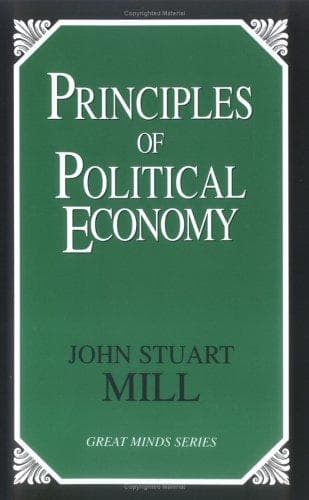
Principles of Political Economy: Abridged with Critical, Bibliographical, and Explanatory Notes, and a Sketch of the History of Political EconomyMill, John Stuart
PhilosophyPhilosophy
Principles of Political Economy: Abridged with Critical, Bibliographical, and Explanatory Notes, and a Sketch of the History of Political Economy
Mill, John Stuart
Economics
Others again (but these are rather philanthropists interesting themselves
for the laboring-classes, than the laboring people themselves) are shy of
admitting the interference of authority in contracts for labor: they fear
that if law intervened, it would intervene rashly and ignorantly; they are
convinced that two parties, with opposite interests, attempting to adjust
those interests by negotiation through their representatives on principles
of equity, when no rule could be laid down to determine what was
equitable, would merely exasperate their differences instead of healing
them; but what it is useless to attempt by the legal sanction, these
persons desire to compass by the moral. Every employer, they think,
_ought_ to give _sufficient_ wages; and if he does it not willingly,
should be compelled to it by general opinion; the test of sufficient wages
being their own feelings, or what they suppose to be those of the public.
This is, I think, a fair representation of a considerable body of existing
opinion on the subject.
I desire to confine my remarks to the principle involved in all these
suggestions, without taking into account practical difficulties, serious
as these must at once be seen to be. I shall suppose that by one or other
of these contrivances wages could be kept above the point to which they
would be brought by competition. This is as much as to say, above the
highest rate which can be afforded by the existing capital consistently
with employing all the laborers. For it is a mistake to suppose that
competition merely keeps down wages. It is equally the means by which they
are kept up. When there are any laborers unemployed, these, unless
maintained by charity, become competitors for hire, and wages fall; but
when all who were out of work have found employment, wages will not, under
the freest system of competition, fall lower. There are strange notions
afloat concerning the nature of competition. Some people seem to imagine
that its effect is something indefinite; that the competition of sellers
may lower prices, and the competition of laborers may lower wages, down to
zero, or some unassignable minimum. Nothing can be more unfounded. Goods
can only be lowered in price by competition to the point which calls forth
buyers sufficient to take them off; and wages can only be lowered by
competition until room is made to admit all the laborers to a share in the
distribution of the wages-fund. If they fell below this point, a portion
of capital would remain unemployed for want of laborers; a
counter-competition would commence on the side of capitalists, and wages
would rise.
Public-domain text, read in full here on John Shaqi.
Reviews
Reviews
No reviews yet
Be the first to share your thoughts on this work.
Elsewhere in the archive
Join the Discussion
Join the discussion
Sign in to leave a comment or review.
Sign InorCreate an account