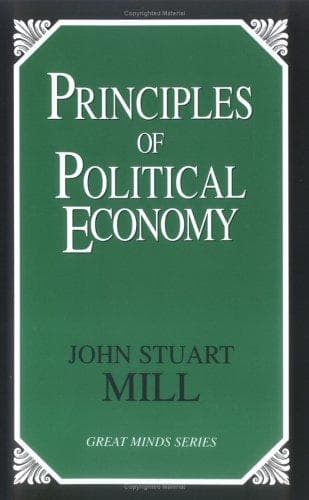
Principles of Political Economy: Abridged with Critical, Bibliographical, and Explanatory Notes, and a Sketch of the History of Political EconomyMill, John Stuart
PhilosophyPhilosophy
Principles of Political Economy: Abridged with Critical, Bibliographical, and Explanatory Notes, and a Sketch of the History of Political Economy
Mill, John Stuart
Economics
The assumption in the last chapter in regard to competition and
custom should be kept in mind in all this reasoning. As a matter
of fact, there is not that mobility of labor which insures so free
an operation of competition that equality of payment always
exists. In reality there is no competition at all between the
lower grades of laborers and the higher classes of skilled labor.
Of course, the _tendency_ is as explained by Mr. Mill, and as time
goes on there is a distinctly greater mobility of labor visible.
Vast numbers pass from Scandinavia and other countries of Europe
to the United States, or from England to Australia, urged by the
desire to go from a community of low to one of higher wages.
Since, therefore, the rate of wages which results from competition
distributes the whole wages-fund among the whole laboring population, if
law or opinion succeeds in fixing wages above this rate, some laborers are
kept out of employment; and as it is not the intention of the
philanthropists that these should starve, they must be provided for by a
forced increase of the wages-fund—by a compulsory saving. It is nothing to
fix a minimum of wages unless there be a provision that work, or wages at
least, be found for all who apply for it. This, accordingly, is always
part of the scheme, and is consistent with the ideas of more people than
would approve of either a legal or a moral minimum of wages. Popular
sentiment looks upon it as the duty of the rich, or of the state, to find
employment for all the poor. If the moral influence of opinion does not
induce the rich to spare from their consumption enough to set all the poor
at work at “reasonable wages,” it is supposed to be incumbent on the state
to lay on taxes for the purpose, either by local rates or votes of public
money. The proportion between labor and the wages-fund would thus be
modified to the advantage of the laborers, not by restriction of
population, but by an increase of capital.
§ 2. —Would Require as a Condition Legal Measures for Repression of
Population.
Public-domain text, read in full here on John Shaqi.
Reviews
Reviews
No reviews yet
Be the first to share your thoughts on this work.
Elsewhere in the archive
Join the Discussion
Join the discussion
Sign in to leave a comment or review.
Sign InorCreate an account