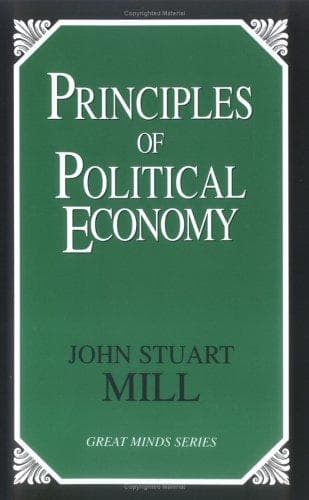
Principles of Political Economy: Abridged with Critical, Bibliographical, and Explanatory Notes, and a Sketch of the History of Political EconomyMill, John Stuart
PhilosophyPhilosophy
Principles of Political Economy: Abridged with Critical, Bibliographical, and Explanatory Notes, and a Sketch of the History of Political Economy
Mill, John Stuart
Economics
A connected and comprehensive grasp of principles was the great
achievement of Adam Smith;(28) for, although the “Wealth of Nations” was
naturally not without faults, it has been the basis of all subsequent
discussion and advance in political economy. In Books I and II his own
system is elucidated, while Book IV contains his discussion of the
Agricultural School and the attacks on the mercantile system. Seeing
distinctly that labor was the basis of all production (not merely in
agriculture), he shows (Books I and II) that the wealth of a country
depends on the skill with which its labor is applied, and upon the
proportion of productive to unproductive laborers. The gains from division
of labor are explained, and money appears as a necessary instrument after
society has reached such a division. He is then led to discuss prices
(market price) and value; and, since from the price a distribution takes
place among the factors of production, he is brought to wages, profit, and
rent. The functions of capital are explained in general; the separation of
fixed from circulating capital is made; and he discusses the influence of
capital on the distribution of productive and unproductive labor; the
accumulation of capital, money, paper money, and interest. He, therefore,
gets a connected set of ideas on production, distribution, and exchange.
On questions of production not much advance has been made since his day;
and his rules of taxation are now classic. He attacked vigorously the
balance-of-trade theory, and the unnatural diversion of industry in
England by prohibitions, bounties, and the arbitrary colonial system. In
brief, he held that a plan for the regulation of industry by the
Government was indefensible, and that to direct private persons how to
employ their capital was either hurtful or useless. He taught that a
country will be more prosperous if its neighbors are prosperous, and that
nations have no interest in injuring each other. It was, however, but
human that his work should have been somewhat defective.(29) A new period
in the history of political economy, however, begins with Adam Smith. As
Roscher says, he stands in the center of economic history.
Public-domain text, read in full here on John Shaqi.
Reviews
Reviews
No reviews yet
Be the first to share your thoughts on this work.
Join the Discussion
Join the discussion
Sign in to leave a comment or review.
Sign InorCreate an account