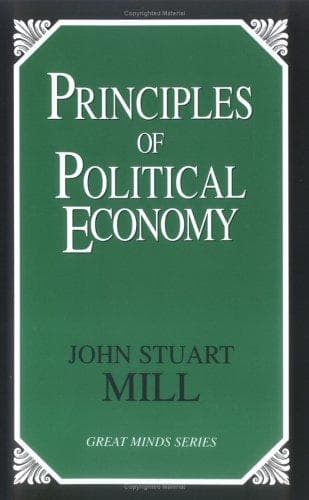
Principles of Political Economy: Abridged with Critical, Bibliographical, and Explanatory Notes, and a Sketch of the History of Political EconomyMill, John Stuart
PhilosophyPhilosophy
Principles of Political Economy: Abridged with Critical, Bibliographical, and Explanatory Notes, and a Sketch of the History of Political Economy
Mill, John Stuart
Economics
New writers now appear who add gradually stone after stone to the good
foundation already laid, and raise the edifice to fairer proportions. The
first considerable addition comes from a contribution by a country
clergyman, Thomas Robert Malthus,(30) in his “Essay on the Principles of
Population” (1798). Against the view of Pitt that “the man who had a large
family was a benefactor to his country,” Malthus argued conclusively that
“a perfectly happy and virtuous community, by physical law, is constrained
to increase very rapidly.... By nature human food increases in a slow
arithmetical ratio; man himself increases in a quick geometrical ratio,
unless want and vice stop him.” In his second edition (1803), besides the
positive check of vice and want, he gave more importance to the negative
check of “self-restraint, moral and prudential.” The whole theory was
crudely stated at first; and it raised the cry that such a doctrine was
inconsistent with the belief in a benevolent Creator. In its essence, the
law of population is simply that a tendency and ability exist in mankind
to increase its numbers faster than subsistence, and that this result
actually will happen unless checks retard it, or new means of getting
subsistence arise. If an undue increase of population led to vice and
misery, in Malthus’s theory, he certainly is not to be charged with
unchristian feelings if he urged a self-restraint by which that evil
result should be avoided. Malthus’s doctrines excited great discussion:
Godwin says that by 1820 thirty or forty answers to the essay had been
written; and they have continued to appear. The chief contributions have
been by A. H. Everett, “New Ideas on Population” (1823), who believed that
an increase of numbers increased productive power; by M. T. Sadler, “Law
of Population” (1830), who taught that human fertility varied inversely
with numbers, falling off with density of population; by Sir Archibald
Alison, “Principles of Population” (1840), who reasoned inductively that
the material improvement of the human race is a proof that man can produce
more than he consumes, or that in the progress of society preventive
checks necessarily arise; by W. R. Greg, “Enigmas of Life” (1873); and by
Herbert Spencer, “Westminster Review” (April, 1852), and “Principles of
Biology,” (part vi, ch. xii and xiii), who worked out a physiological
check, in that with a mental development out of lower stages there comes
an increased demand upon the nervous energy which causes a diminution of
fertility. Since Darwin’s studies it has been very generally admitted that
it is the innate _tendency_ of all organic life to increase until numbers
press upon the limit of food-production; not that population has always
done so in every country.(31) Malthus’s teachings resulted in the modern
poor-house system, beginning with 1834 in England, and they corrected some
of the abuses of indiscriminate charity.
Public-domain text, read in full here on John Shaqi.
Reviews
Reviews
No reviews yet
Be the first to share your thoughts on this work.
Join the Discussion
Join the discussion
Sign in to leave a comment or review.
Sign InorCreate an account