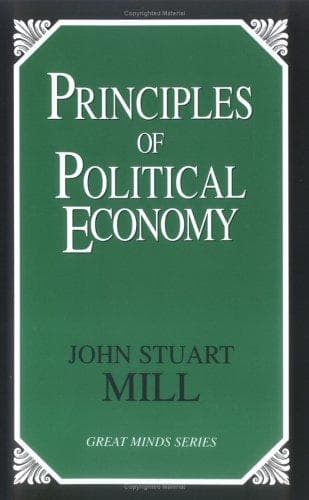
Principles of Political Economy: Abridged with Critical, Bibliographical, and Explanatory Notes, and a Sketch of the History of Political Economy — John Shaqi
Principles of Political Economy: Abridged with Critical, Bibliographical, and Explanatory Notes, and a Sketch of the History of Political EconomyMill, John Stuart
PhilosophyPhilosophy
Principles of Political Economy: Abridged with Critical, Bibliographical, and Explanatory Notes, and a Sketch of the History of Political Economy
Mill, John Stuart
Economics
By far the ablest of the group, both by reason of his natural gifts and
his training as a banker and financial editor, was Walter Bagehot.(51) In
his “Economic Studies” (1880) he has discussed with a remarkable economic
insight the postulates of political economy, and the position of Adam
Smith, Ricardo, and Malthus; in his “Lombard Street” (fourth edition,
1873), the money market is pictured with a vivid distinctness which
implies the possession of rare qualities for financial writing; indeed, it
is in this practical way also, as editor of the London “Economist,”(52)
that he made his great reputation.
Of living English economists, Professor Henry Fawcett,(53) in his “Manual
of Political Economy” (1865; sixth edition, 1883), is a close follower of
Mill, giving special care to co-operation, silver, nationalization of
land, and trades-unions. He is an exponent of the strict wages-fund
theory, and a vigorous free-trader. Professor J. E. Thorold Rogers, of
Oxford, also holds aloof from the methods of the old school. His greatest
contribution has been a “History of Agriculture and Prices in England,”
from 1255 to 1793, in four volumes(54) (1866-1882).
Of all the writers(55) since Cairnes, it may be said that, while adding to
the data with which political economy has to do, and putting principles to
the test of facts, they have made no actual addition to the existing body
of principles; although questions of distribution and taxation are
certainly not yet fully settled, as is seen by the wide differences of
opinion expressed on subjects falling within these heads by writers of
to-day.
Public-domain text, read in full here on John Shaqi.
Reviews
Reviews
No reviews yet
Be the first to share your thoughts on this work.
Join the Discussion
Join the discussion
Sign in to leave a comment or review.
Sign InorCreate an account