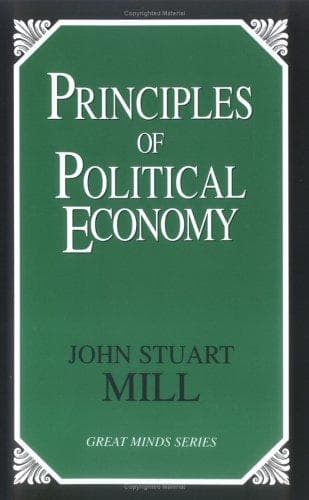
Principles of Political Economy: Abridged with Critical, Bibliographical, and Explanatory Notes, and a Sketch of the History of Political EconomyMill, John Stuart
PhilosophyPhilosophy
Principles of Political Economy: Abridged with Critical, Bibliographical, and Explanatory Notes, and a Sketch of the History of Political Economy
Mill, John Stuart
Economics
It now remains to complete this sketch of the growth of political economy
by a brief account of the writers on the Continent and in the United
States, beginning with France. About the time of the founding of the
London “Economist” (1844) and “The Statistical Journal” (1839) in England,
there was established in Paris the “Journal des Économistes” (1842), which
contains many valuable papers. On the whole, the most popular writer since
J. B. Say has been Bastiat,(56) who aspired to be the French Cobden. He
especially urged a new(57) view of value, which he defined as the relation
established by an exchange of services; that nature’s products are
gratuitous, so that man can not exact anything except for a given service.
Chiefly as a foe of protection, which he regarded as qualified socialism,
he has won a reputation for popular and clever writing; and he was led to
believe in a general harmony of interests between industrial classes; but
in general he can not be said to have much influenced the course of French
thought. On value, rent, and population, he is undoubtedly unsound. A
writer of far greater depth than Bastiat, with uncommon industry and wide
knowledge, was Michel Chevalier,(58) easily the first among modern French
economists. He has led in the discussion upon the fall of gold,
protection, banking, and particularly upon money; an ardent free-trader,
he had influence enough to induce France to enter into the commercial
treaty of 1860 with England. One of the ablest writers on special topics
is Levasseur,(59) who has given us a history of the working-classes before
and since the Revolution, and the best existing monograph on John Law. The
most industrious and reliable of the recent writers is the well-known
statistician, Maurice Block,(60) while less profound economists were J. A.
Blanqui(61) and Wolowski.(62) The latter devoted himself enthusiastically
to banks of issue, and bimetallism. A small group gave themselves up
chiefly to studies on agriculture and land-tenures—H. Passy,(63) Laveleye,
and Lavergne.(64) The latter is by far the most important, as shown by his
“L’économie rurale de la France depuis 1789” (1857), which gives a means
of comparing recent French agriculture with that before the Revolution, as
described in Arthur Young’s “Travels in France” (1789). The best
systematic treatise in French is the “Précis de la science économique”
(1862), by Antoine-Élise Cherbuliez,(65) a Genevan. The French were the
first to produce an alphabetical encyclopædia of economics, by Coquelin
and Guillaumin, entitled the “Dictionnaire de l’économie politique”
(1851-1853, third edition, 1864). Courcelle-Seneuil,(66) by his “Traité
théorique et pratique d’économie politique” (second edition, 1867); and
Baudrillart, by a good compendium. Joseph Garnier, Dunoyer,(67) Paul
Leroy-Beaulieu,(68) Reybaud,(69) De Parieu,(70) Léon Say,(71) Boiteau, and
others, have done excellent work in France, and Walras(72) in Switzerland.
Public-domain text, read in full here on John Shaqi.
Reviews
Reviews
No reviews yet
Be the first to share your thoughts on this work.
Join the Discussion
Join the discussion
Sign in to leave a comment or review.
Sign InorCreate an account